
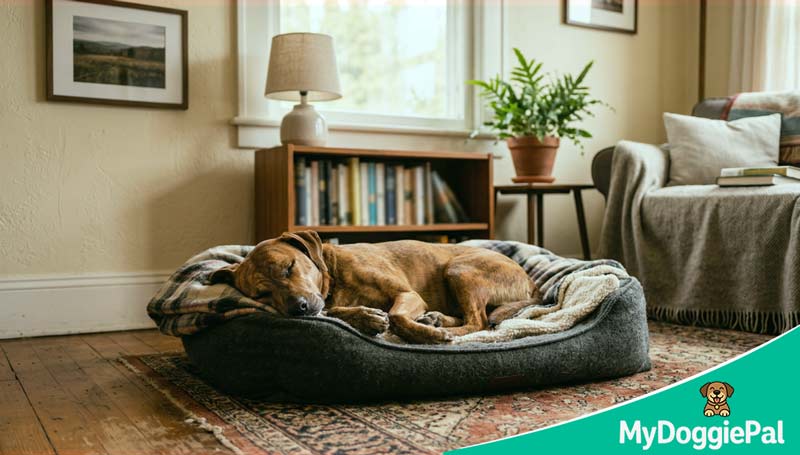
When I first became a dog parent, I wasn’t sure of where they’d sleep
Do they go in the crate? Curl up on their own bed? Or shuffle under your duvet with you?
It sounds like a small decision. But honestly, it keeps a lot of dog owners up at night.
And no, outside doesn’t count. Dogs belong indoors at night. That’s not up for debate. But once we’re past that, the choice between a crate, a dog bed, and your own bed? That’s where things get interesting.
This guide is judgment-free. There’s no single right answer here. What works for a friend’s dog might not work for yours. What you read online might not match your lifestyle at all.
So we’re going to walk through each option honestly: the good, the bad, and the stuff nobody tells you, so you can make the best call for both of you.
Why Where Your Dog Sleeps Actually Matters
Let’s be clear about something first. This isn’t just about comfort.
Where should dogs sleep? It’s a question that affects more than you might think.
Dogs sleep between 12 and 14 hours a day. That means the place they sleep is one of the biggest constants in their life. Get it right, and you get a calmer, more settled dog. Get it wrong, and you might be dealing with anxiety, disrupted behavior, or broken sleep – yours and theirs.
Where they sleep shapes their sense of security. It sets a routine. And it can affect how they handle being alone during the day too.
Your sleep matters just as much. A dog that wakes you up three times a night isn’t just annoying. Over time it affects your mood, your health, and your patience.
And if you have a puppy, the stakes are even higher. Puppies need sleep support in a way adult dogs simply don’t.
The size of your home, your household, your work schedule, your dog’s breed and age all plays a role. So let’s look at each option properly.
Got a new puppy? Discover how to build a sleep routine that works from night one. Read our puppy sleep guide here.
Dog Crate vs Bed: Is a Crate the Right Choice for Your Dog?

The crate divides opinion more than almost anything in dog ownership.
Some people see a crate and feel immediately uncomfortable. It looks like a cage. It feels like a punishment. And if that’s your gut reaction, you’re not alone.
But here’s what the gut reaction misses: dogs are den animals. It’s in their DNA. Their ancestors sought out small, enclosed, dark spaces to rest. These are places where they felt protected and hidden. A well-introduced crate taps into exactly that instinct.
When your dog chooses to nap in their crate during the day with the door wide open? That’s the instinct at work.
The key phrase there is well-introduced. A crate that’s been rushed, forced, or used as punishment is a very different thing. We’ll come back to that.
Pros of Using a Crate at Night
- It gives your dog a genuinely safe space. Not safe in a soft, sentimental way. Safe as in: no chewing cables at 2am. No getting into the bin. No falling down the stairs in the dark.
- It supports house training. Dogs naturally avoid soiling where they sleep. This makes the crate one of the most effective tools for teaching puppies bladder control overnight.
- It helps with separation anxiety long term. A dog that learns to self-soothe in a crate becomes more confident and independent over time. The crate becomes their place.
- It makes travel so much easier. A crate-trained dog is calmer on car journeys, in hotels, at the vet, and at the groomer. All of those situations involve being confined around unfamiliar smells and people. A dog that knows and trusts a crate handles all of it far better.
- It helps in multi-pet households. Clear overnight boundaries reduce resource guarding and tension between animals.
Cons of Using a Crate at Night
- Done wrong, it causes real harm. A dog forced into a crate before they’re ready, or shut in one for too many hours overall, will not thrive. It’s worth being honest about this.
- It’s not suitable for every dog. Some dogs, despite patient introductions, never fully relax in a crate. That’s okay. It doesn’t mean you’ve failed.
- It takes up space. A crate for a Labrador or a German Shepherd is a significant piece of furniture. Not every home can accommodate that easily.
- It takes time to introduce properly. You can’t put a dog in a crate on night one and expect peace. The introduction is a process.
MYTH-BUST
“Crating Is Cruel”
Crating is only cruel when it’s done poorly. A crate introduced with patience, treats, and positive association becomes a dog’s sanctuary, not a sentence.
Think of it like the blanket fort you built as a kid. Small, enclosed, yours. That’s how a well-trained dog feels about their crate.
WHO THIS WORKS BEST FOR
- Puppies who are still learning bladder control
- Dogs with destructive overnight habits
- Dogs being introduced to a new home
- Frequent travellers with dogs
- Owners who need clear, consistent boundaries at night
CRATE SIZING MADE SIMPLE
Height: Measure from the top of your dog’s head to the floor. Add 3 to 4 inches.
Length: Measure from nose to the base of the tail. Add 3 to 4 inches.
For puppies: Choose a crate with an adjustable divider panel so it grows with them.
Wire crates: Great ventilation, durable, best for most dogs.
Plastic crates: Ideal for travel, airline-approved, more den-like feel.
Soft-sided crates: Only suitable for very calm, non-destructive dogs.
Ready to Move On? How to Transition From a Crate to a Dog Bed
At some point, most owners want to give their dog more freedom overnight. Here’s how to do it without undoing all your training.
- Step 1: Leave the crate door unlocked and slightly open for a few nights. Don’t rush. Let them choose.
- Step 2: Keep them contained to one room. Too much freedom all at once can be overwhelming even for confident dogs.
- Step 3: Open the crate door fully at bedtime. Settle them as normal. They still have the crate as an option if they want it.
- Step 4: Once they’re consistently sleeping outside the crate, remove it. Let them sleep on the mat or cushion they used inside the crate. The familiarity helps.
- Step 5: Once that’s working well, introduce the new dog bed.
The whole process takes patience. There’s no fixed timeline. Some dogs move through it in two weeks. Others take two months. Follow your dog’s lead.
If you want to crate train the right way without the stress, read our step-by-step crate training guide here.
Using a Dog Bed : The Middle-Ground Most Owners Love

If the crate feels too restrictive and your bed feels like too much, a dog bed is where most owners land, and for good reason.
When people ask about dog crate vs bed options, the dog bed is almost always the lowest-friction choice. There’s no training process. No adjustment period. No guilt. You put it down. Your dog (hopefully) uses it.
It gives your dog their own defined space without confining them. And it gives you a clear, clean boundary at night.
Pros of a Dog Bed
- Your dog has comfort and freedom. They can stretch out, shift around, and sleep in whatever position they like. No door. No walls.
- Your sleep stays undisturbed. There’s no wriggling next to you, no paws in your face, no 3am rearrangements.
- Orthopedic options make a real difference for older dogs. If your dog has arthritis or joint issues, a good memory foam bed isn’t a luxury. It’s a genuine health need.
- Easy to keep clean. Most quality dog beds have removable, machine-washable covers. That matters more than people realise.
- It keeps shedding and dander contained. Your furniture stays cleaner. If anyone in the house has mild allergies, this is a significant win.
- Your dog develops a sense of ownership. Having their own space builds quiet confidence in a dog. It’s subtle, but it shows.
Cons of a Dog Bed
- Some dogs ignore it completely. Especially if they’ve been co-sleeping and suddenly get demoted. The bed might sit untouched for weeks.
- Very anxious dogs may struggle. A dog that needs closeness to feel safe might not settle on a bed across the room.
- The wrong bed is a waste of money. Too small, too soft, or made from the wrong fabric and it simply doesn’t work.
Not Ready for Full Separation? Try the Bedroom Floor Setup
This one doesn’t get talked about enough.
You don’t have to choose between dog in the bed and dog in another room. A dog bed placed in your bedroom, close to where you sleep, is genuinely one of the best setups for many dogs and owners.
Your dog can sense you. Hear you breathing. Smell you. That’s enough for most dogs to feel completely settled.
You get an undisturbed sleep. And they get the security of proximity without being plastered to your legs all night.
This setup works brilliantly as a stepping stone too. If you’re trying to move a dog out of your bed, starting with a dog bed on the bedroom floor is far more successful than going cold turkey with a bed in another room.
WHO THIS WORKS BEST FOR
- Adult dogs with established routines
- Owners who want boundaries without confinement
- Dogs with joint or mobility issues (with the right orthopedic bed)
- Multi-dog households where everyone needs their own space
- Owners transitioning away from co-sleeping
WHAT TO LOOK FOR IN A DOG BED
Size: Your dog should be able to stretch out fully without hanging off the edge.
Support: Memory foam or orthopedic filling for larger or older dogs.
Washability: Removable cover that goes in the washing machine.
Durability: Tougher outer fabric for dogs who like to dig and circle before lying down
Not sure which dog bed to buy? See our top-rated picks for every size, breed and budget view the dog beds roundup here.
Should Your Dog Sleep in Bed With You? The Honest Pros and Cons
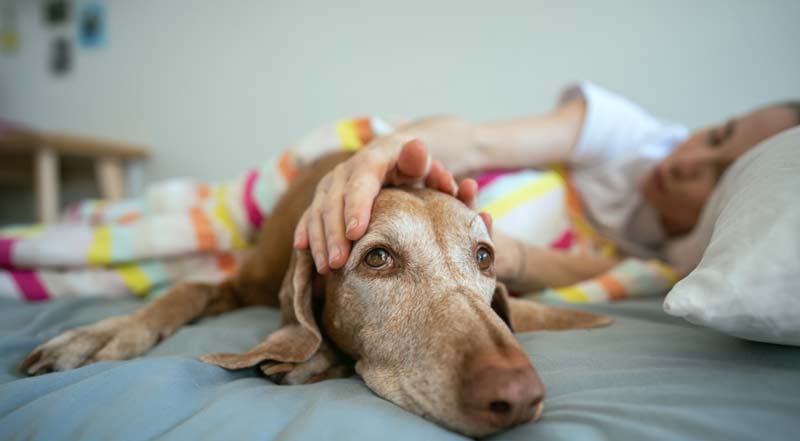
Here it is. The big one.
Should your dog sleep in bed with you? And what are the real letting dog sleep in bed pros and cons that nobody talks about honestly?
Roughly half of all dog owners let their dogs sleep in their bed. Many of them love it. Some of them wish they’d set boundaries earlier. And almost all of them have been told at some point that they’re doing it wrong.
Let’s look at both sides clearly.
Pros of Co-Sleeping With Your Dog
- It deepens your bond. Sleeping next to someone or something – is an act of trust. Dogs know that. The closeness reinforces your relationship in a way that daytime interaction alone doesn’t always match.
- It’s comforting for anxious dogs. Some dogs are genuinely calmer, more settled, and more confident the next day when they’ve slept close to their owner.
- It reduces loneliness. For owners who live alone, or who are going through a difficult time, there’s real emotional comfort in having your dog nearby at night. That’s not weakness. That’s human.
- Many owners sleep better too. Not worse. Better. The feeling of safety and warmth that comes with a sleeping dog next to you is something a lot of owners underestimate until they experience it.
WHAT THE RESEARCH ACTUALLY SAYS
You’ve probably heard that letting your dog sleep in your bed will ruin your sleep. Science tells a more nuanced story.
A Mayo Clinic study looked at how sleeping with a dog affected sleep efficiency. The result? Sleep efficiency was adequate whether the dog was on the bedroom floor or in the bed itself.
A separate study from Canisius College surveyed 962 women about their sleep experiences. Those who slept with a dog in the bed reported sleeping more soundly and feeling more secure than those sleeping with a human partner or a cat.
Should your dog sleep in bed with you? The research is far less alarming than people make out. But it’s still not for everyone.
Cons of Co-Sleeping With Your Dog
- It can disrupt your sleep. Large dogs, restless movers, dogs that get on and off through the night can break your sleep cycle in ways you don’t immediately notice but definitely feel the next day.
- Hygiene takes more effort. Whatever your dog walked through that afternoon is now in your bed. If they’re not on a regular flea and worming treatment, that becomes a more serious issue quickly.
- It can reinforce separation anxiety. For some dogs, being that close to you at night makes daytime separation harder. If your dog already struggles when you leave the house, co-sleeping might be making it worse.
- Territorial or possessive behavior can develop. Some dogs begin to guard the bed, growling when a partner gets in, or becoming difficult to move. This is worth watching for.
- Large and senior dogs face physical risks. Jumping on and off a high bed repeatedly puts real strain on joints. Consider a dog ramp or bed steps before committing to co-sleeping.
- Allergies get worse. Dog dander in your sleeping environment every single night is a significant exposure. Even people with mild allergies often find their symptoms noticeably worse after a few weeks of co-sleeping.
MYTH-BUST
“Letting Your Dog Sleep in Your Bed Makes Them Dominant”
This idea comes from outdated dominance theory that the dog behavior world has largely moved on from. Dogs are not plotting to take over your bedroom. If your dog nudges you to the edge of the mattress, they’re seeking warmth and closeness — not asserting rank. The American Kennel Club and modern veterinary behaviorists agree: co-sleeping doesn’t create dominance issues in otherwise well-trained, confident dogs.
WHO THIS WORKS BEST FOR
- Single owners or couples who both actively choose it
- Small to medium, calm, well-trained dogs on regular parasite treatment
- Owners without allergies or diagnosed sleep issues
- Dogs that don’t show resource-guarding tendencies
Dog Crate vs Bed vs Co-Sleeping: Quick Comparison Table
When comparing dog crate vs bed options alongside co-sleeping, it helps to see everything side by side.
| Factor | Crate | Dog Bed | Your Bed |
|---|---|---|---|
| Your sleep quality | Good | Good | Varies |
| Dog's comfort | Good when trained | Great | Great |
| Hygiene | Easy | Easy | More effort |
| Bonding | Neutral | Neutral | Strong |
| Anxiety support | Strong long-term | Neutral | Can backfire |
| Best for puppies | Yes | Sometimes | Not ideal |
| Best for senior dogs | With soft bedding | Orthopedic bed ideal | Access issues |
| Travel and lifestyle | Very practical | Neutral | Not portable |
| Training required | Yes | Minimal | None |
| Large dog friendly | Yes with right size | Yes | Needs ramp or steps |
No option is perfect. The best place for a dog to sleep at night is simply the one that works for both of you, long-term, without creating bigger problems down the line.
What’s the Best Place for Your Dog to Sleep at Night?
Let’s make this decision as simple as we can.
The best place for your dog to sleep at night depends on a handful of key factors. Here’s a straightforward breakdown:
For a puppy
Start with a crate near your bed. Move to a dog bed as they grow and their bladder control improves.
For an anxious dog
A properly introduced crate is often the better long-term solution. Or a dog bed placed in your bedroom so they can sense you without being in your bed.
For a light sleeper
A dog bed or crate is almost certainly your best option. Co-sleeping with an active or restless dog will wear you down faster than you expect.
Allergies
Keep the dog out of the bedroom if possible. A dog bed in the living room or hallway is the practical choice.
Bonding first
Co-sleeping can work well, but set ground rules from the start. Don’t let it drift into something that causes problems later.
Large or elderly?
An orthopedic dog bed is genuinely one of the kindest things you can give them. If you want them near you, put the bed in your bedroom rather than having them climb in and out of yours.
Unsure?
Start with a dog bed. It’s the easiest option to adjust, the lowest-commitment setup, and the one most dogs adapt to without drama.
Do You Have to Choose? The Crate and Dog Bed Combo
Here’s something a lot of guides skip over entirely.
You don’t have to pick just one.
Many owners use both a crate and a dog bed and it works really well. The crate at night, a dog bed in the living room during the day. Or a crate in the bedroom for sleeping, and a bed near the sofa for daytime naps.
Dogs sleep 12 to 14 hours every day. They benefit from having more than one comfortable spot across the home.
When it comes to dog crate vs bed, you don’t always have to pick a side. Using both gives you the structure of the crate when you need it, and the comfort of a dog bed when they just want to sprawl out in the afternoon.
A Few Tips That Make Any Sleeping Setup Work Better
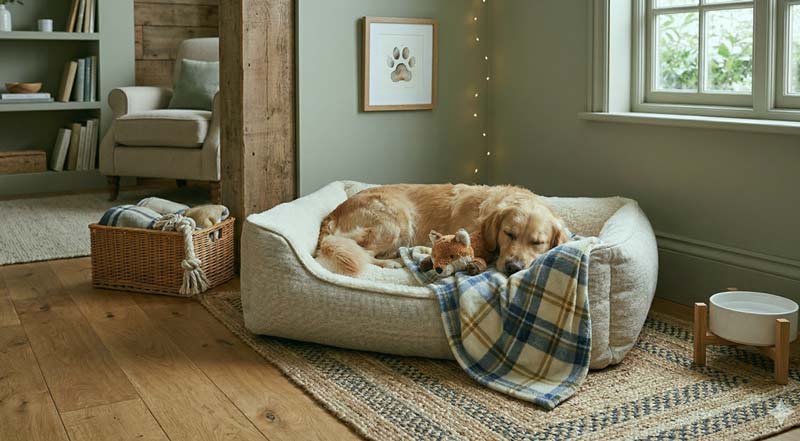
Whichever option you go with, these tips make a real difference.
Be consistent. Pick a spot and stick to it. Dogs thrive on routine. Changing the setup frequently confuses them and undoes the progress you’ve made.
Keep the sleep area calm, dark and quiet. Dogs sleep better in a darkened room with minimal noise. If the sleep spot is near a window with outside light or street noise, that’ll affect how well they settle.
Stay away from drafts. A dog’s bed or crate should be in a warm spot, away from windows and exterior walls that get cold overnight.
Think about coat type and temperature. Long-haired breeds often seek out cooler spots to sleep. Short-haired breeds, especially smaller ones, need warmth. A short-haired dog on a cold floor without adequate bedding will be uncomfortable and restless all night.
Wash bedding regularly. Whatever setup you choose, bedding needs washing far more often than most people manage. Every one to two weeks is realistic. Dog beds with removable, machine-washable covers make this much easier.
If you’re switching setups, do it gradually. Going from crate to bed, or from co-sleeping to a dog bed, works best as a slow transition. Patience gets results that abruptness doesn’t.
Puppies and older dogs are both more noise-sensitive at night. Put their sleep spot in the quietest part of your home. A dog that keeps barking at outside sounds overnight isn’t a difficult dog, they’re just reacting to an environment that isn’t set up well for sleep.
Want to set up the perfect sleep space from scratch? Here’s exactly what your dog’s sleep environment needs, read the full sleep environment guide here.