
Your dog’s sleep has changed and you want to know if it matters. That’s the right question to be asking.
Most of the time, a dog sleeping too much or too little is not a health problem. But some changes are. This guide helps you tell the difference, gives you a 60-second test to do at home, and tells you exactly how urgently to act.
The key question isn’t how many hours your dog sleeps. It’s how they are when they wake up. Keep that in mind as you read.
How Much Should a Dog Sleep? Normal Ranges by Age
Use this as your reference point throughout the article.
How Much Should a Dog Sleep
| Life Stage | Age | Normal Sleep per 24 Hours |
|---|---|---|
| Newborn puppy | 0 to 4 weeks | 20 to 22 hours |
| Young puppy | 4 to 16 weeks | 18 to 20 hours |
| Adolescent puppy | 4 to 12 months | 16 to 18 hours |
| Adult dog | 1 to 7 years | 12 to 14 hours |
| Senior dog | 7+ years | 14 to 18 hours |
A few things worth noting alongside the table:
Giant breeds like Great Danes and Mastiffs naturally sit at the upper end of the adult range, often sleeping 14 to 16 hours even as healthy adults. Small and toy breeds also tend toward the higher end. Working and sporting breeds in active households often sleep closer to 12 hours.
These ranges include all sleep: overnight rest plus every daytime nap. Owners who only count night-time hours will almost always think their dog is sleeping too much.
For the full breakdown of sleep norms at every life stage, see our guide on how much sleep dogs need.
Dog Lethargy vs Sleepiness: These Are Not the Same Thing
This is the most important distinction in the article. Most owners conflate the two. Getting it right tells you whether you have a dog who needs a nap or a dog who needs a vet.
Normal sleepiness means your dog sleeps more than usual, but when they wake, they are alert and engaged. They respond to their name, get up for food and their personality when awake is unchanged. The quantity has shifted but the quality of their waking hours has not.
Lethargy is different. A lethargic dog isn’t just sleeping more. They seem flat or dull when they are awake. Slow to respond. Less interested in food, play, and interaction. The waking hours feel different, not just the sleeping ones.
The question is not how many hours your dog sleeps. A dog sleeping 16 hours but waking bright and engaged is almost certainly fine. A dog sleeping 14 hours but waking groggy, flat, and unresponsive every single time is not.
Lethargy is a waking problem that shows up alongside extra sleep, not a sleep problem on its own.
THE ROUSAL TEST: TRY THIS RIGHT NOW
You can tell the difference between sleepiness and lethargy in about 60 seconds. Try these in order:
- Say your dog’s name in your normal voice from across the room
- Make the sound of their lead being picked up, or say “walkies” or “dinnertime”
- Offer their favourite treat right in front of their nose
A sleepy dog responds to at least one of these. They may be slow to get up, but they will get up.
A lethargic dog shows little or no response, even to food. If your dog cannot be roused by their favourite treat, that is not tiredness. That is a symptom. Call your vet.
Is My Dog Sleeping Too Much? How to Tell
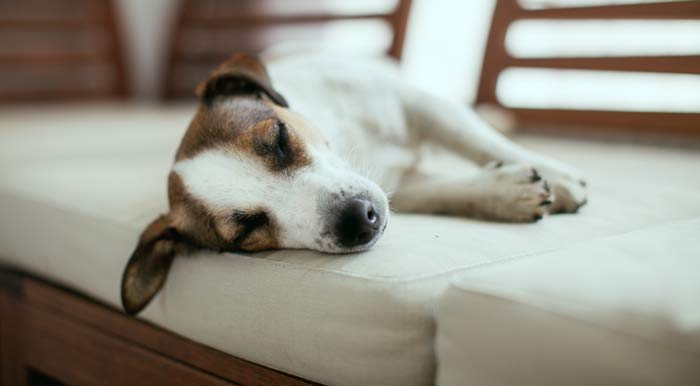
A dog sleeping a lot is usually normal. The more meaningful signal is whether your dog is sleeping noticeably more than their own personal usual baseline, not just more than the chart.
Common Non-Medical Reasons for Extra Sleep
- Recovery after a high-activity day. A long hike, a big play session, or a training day will produce extra sleep. That is the body doing exactly what it should.
- Seasonal shift. Many dogs sleep more in winter. Shorter days, less daylight, quieter households.
- Boredom. Under-stimulated dogs sleep out of lack of anything else to do. Common, and not a health concern.
- New medication. Many medications list drowsiness as a side effect. Post-vaccination tiredness is normal for 24 to 48 hours.
- Recent routine change. A new home, a new household member, a shift in work schedule. Adjustment tiredness is real and temporary.
When the Extra Sleep Warrants Attention
- It has been going on for several consecutive days or weeks, not just one tired day
- It came on suddenly rather than gradually
- It is paired with any red-flag symptom from the checklist below
The dog oversleeping symptoms that accompany the extra sleep tell you far more than the sleep itself does.
When to Worry About Your Dog Sleeping: The Red-Flag Checklist
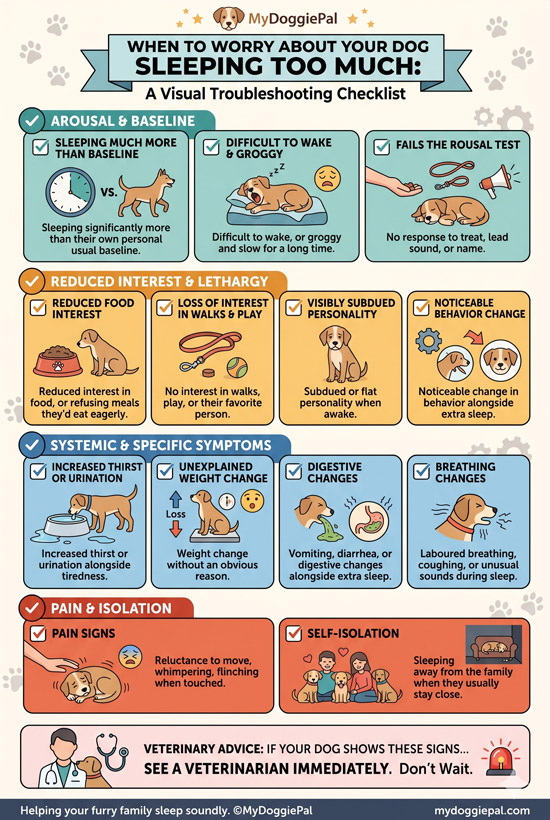
If your dog is sleeping more than usual and showing one or more of the following, book a vet appointment.
- Sleeping significantly more than their own personal usual baseline
- Difficult to wake, or groggy and slow for a long time after waking
- Fails the Rousal Test: no response to treat, lead sound, or name
- Reduced interest in food, or refusing meals they would normally eat eagerly
- Loss of interest in walks, play, or their favourite person
- Visibly subdued or flat personality when awake
- Noticeable change in behaviour alongside the extra sleep
- Increased thirst or urination alongside tiredness
- Weight change without an obvious reason
- Vomiting, diarrhoea, or digestive changes alongside extra sleep
- Breathing changes: laboured breathing, coughing, or unusual sounds during sleep
- Pain signs: reluctance to move, whimpering, flinching when touched
- Self-isolation: sleeping away from the family when they usually stay close
These dog oversleeping symptoms form your body of evidence. One alone might not mean much. Two or more together warrant a call.
A Quick At-Home Check: Look at Their Gums
One of the fastest at-home health indicators vets recommend. Gently lift your dog’s upper lip and look at the gum tissue above the teeth.
| Gum Colour | What It Suggests | What to Do |
|---|---|---|
| Pink and moist | Normal, healthy circulation | No action needed |
| Pale pink or white | Possible anaemia or internal bleeding | Call vet today |
| Bright red | Possible overheating or toxin exposure | Call vet today |
| Blue or purple | Cardiovascular or respiratory emergency | Emergency vet immediately |
| Yellow | Possible liver involvement | Call vet today |
| Sticky or dry | Possible dehydration | Call vet today |
Gum colour is a triage tool, not a diagnosis. It helps you decide how urgently to act. Pink and moist means healthy circulation. Anything else means call.
Health Conditions That Can Make a Dog Sleep Too Much
- Hypothyroidism. Underactive thyroid causes lethargy, weight gain, and increased sleep. Common in middle-aged and older dogs. Diagnosed by blood test and highly treatable.
- Anaemia. Reduced red blood cells mean less oxygen to tissues. Fatigue follows quickly. Pale gums are often the first visible sign at home.
- Diabetes. Energy regulation problems cause unusual fatigue, usually alongside increased thirst and urination.
- Heart disease. Reduced cardiac output means the body tires faster. Coughing at night is a common accompanying sign.
- Infection or illness. A dog fighting any infection sleeps more while the immune system works. Sleep usually resolves as the illness does.
- Pain. A dog in pain often sleeps more to cope with discomfort. The sleep tends to be restless rather than deep.
- Canine Cognitive Dysfunction. In senior dogs, CDS causes heavy daytime sleep and nighttime restlessness. For everything on CDS, see our guide on senior dog sleep changes.
- Cancer. Fatigue is one of cancer’s most consistent early symptoms. Worth raising with your vet alongside weight loss or appetite change.
- Medication side effects. Antihistamines, anti-anxiety drugs, and post-surgery medications all commonly cause increased drowsiness.
Dog Sleeping Less Than Usual: When It Is Worth Paying Attention
Most guides ignore this side. A dog sleeping noticeably less than their own usual baseline is also worth tracking.
Common Non-Medical Reasons for Sleeping Less
- New environment or recent change. Anxiety and hypervigilance naturally reduce sleep in the short term.
- A new animal in the house. Excitement and alertness keep some dogs up.
- More activity than usual. Some dogs run on adrenaline and don’t crash immediately.
- Seasonal shift. Longer summer days can shift sleep patterns temporarily.
The Behavioral Effects of Under-Sleeping
A dog that is chronically under-sleeping shows downstream behavioral changes that owners frequently misread as disobedience, personality shifts, or anxiety.
Without adequate rest, dogs lose interest in play, show reluctance on walks, and can become irritable and more reactive to sounds and strangers. They may also become less responsive to commands they know well.
These are dog sleeping less than usual consequences, not behavior problems. The distinction matters because the fix is completely different. If a trainer or vet has flagged deteriorating behavior and there is no obvious cause, disrupted sleep is worth considering.
When Less Sleep Warrants Attention
- Persistent restlessness or inability to settle at night for more than a week
- Pacing, circling, or visible anxiety at sleep time
- Waking frequently through the night over several consecutive nights
- Sleep-wake reversal in senior dogs: sleeping all day, awake and agitated all night
- Inability to settle alongside pain signs: reluctance to lie down, whimpering, repositioning constantly
One or two disrupted nights is almost never a concern. More than a week of inability to settle, especially paired with other changes, is worth a vet conversation.
For a deeper look at sleep problems including restlessness and insomnia, see our guide on dog sleep problems.
What to Do If You Are Worried About Your Dog’s Sleep
If the Change Looks Within Normal Range
- Track it for three to five days. Rough notes on when they sleep and for how long is enough.
- Check whether anything has changed: new medication, a big day out, a shift in routine.
- Watch the waking hours. If they are alert, responsive, and interested in food when awake, the sleep itself is probably fine.
How Urgently Do You Need to Act?
Use this to decide your next step.
TIER 1 | Contact your emergency vet immediately
Blue, white, or purple gums
Difficulty breathing or gasping
Collapse or inability to stand
Tremors or seizure activity alongside lethargy
Suspected poisoning
TIER 2 | Call your vet today
Fails the Rousal Test: no response to treat, lead, or name
Pale, bright red, yellow, or sticky gums
Lethargy alongside vomiting, diarrhoea, or complete appetite loss
Lethargy that appeared suddenly overnight with no obvious trigger
Any breathing changes alongside reduced activity
TIER 3 | Book a routine appointment within the week
Gradual increase in sleep over two or more weeks
Mild appetite reduction alongside extra sleep
Subtle personality or behaviour change alongside more sleep
Sleeping more than usual but passing the Rousal Test
Restlessness at night persisting for more than one week
The Bottom Line
The sleep itself is rarely the whole story. The waking hours are the giveaway. Run the Rousal Test. Check the gums. Use the urgency tiers.
When to worry about dog sleeping comes down to one question: is your dog still themselves when they are awake? If yes, monitor. If no, call.
For everything about dog sleep in one place, visit our complete guide to dog sleep. If your dog is a senior, our senior dog sleep guide covers the specific causes and red flags for older dogs