
Your dog used to settle at 10pm and sleep through until morning. Then the clocks changed, you came back from holiday, or your work hours shifted, and now they are wide awake at 4am and you are too.
This is a schedule problem, not a behavior problem. And it is fixable for most dogs within one to two weeks.
The fix is not complicated. But the order you do things matters more than most guides explain. Here is exactly how to do it:
Why Your Dog’s Sleep Schedule Gets Thrown Off
Dogs run on a 24-hour internal clock, a circadian rhythm, which is governed by three cues: light, meals, and activity. When any one of those anchors shifts, the internal clock drifts.
Unlike humans, dogs cannot reason their way through it. They just feel out of sync. And the body does not snap back overnight. It shifts slowly, which is why a single disrupted night can cascade into a week of wrong-time waking.
The cause of the disruption matters because it determines how far off the clock is, and that tells you which reset method to use.
| Trigger | What's disrupted | How far off |
|---|---|---|
| Daylight saving time | Clock time only | 1 hour |
| Post-holiday / travel | Time zone + new environment | Variable: 1 to 6+ hours |
| Owner schedule change | Meal and activity timing | Gradual drift |
| New home or environment | All anchors - light, meals, walks | 1–2 weeks to stabilise |
| Post-illness or surgery | Physiological rhythm | Variable |
Gradual Reset vs Cold Turkey: A Direct Answer
Most guides say “gradually shift the schedule” without telling you what that actually means in practice. Here is the honest answer.
When cold turkey works
If the offset is just one hour as in daylight saving, or a very short trip, you can flip straight to the new schedule on Day 1. Most dogs with a flexible temperament adjust within three to five days.
Cold turkey also works if the disruption lasted only two or three nights. That is not deep enough to need a gradual reset.
When to go gradual
Anything more than one hour off needs a gradual shift. So does any dog that is naturally anxious, elderly, or has been off-routine for more than a week.
The rule of thumb: allow three to five days of gradual shifting per hour of offset. A dog that is two hours off needs roughly a week to reset comfortably without stress.
Gradual vs Cold Turkey – Quick decision guide
1 hour off (daylight saving, short trip) → cold turkey is fine
2–3 hours off → shift 15 minutes every 1–2 days
4+ hours off (long-haul travel) → shift 15 minutes every 2 days, allow 10–14 days
Anxious or senior dog → always go gradual, whatever the offset
The Three Anchors: What to Shift and In What Order
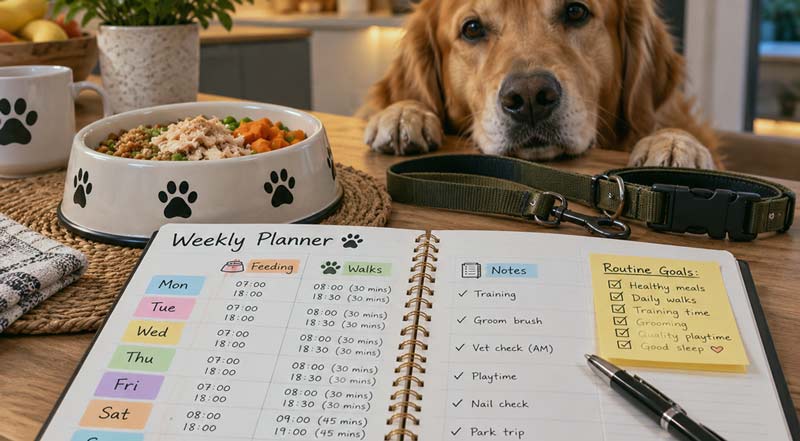
This is where guides reset stall. People shift the bedtime and nothing else, and the body does not follow. The reason is that the internal clock responds to multiple cues, and they need to move in a specific sequence.
1. Morning light – shift this first
Light is the strongest circadian signal in mammals. A PLOS One study tracking sled dogs and pet dogs found that dogs synchronize their activity patterns to sunrise, not to the clock on the wall.
On Day 1 of your reset, take your dog outside at the target wake time, even if they have been up since 4am. Natural morning light at the new target time tells the brain this is when the day starts. It resets the master clock faster than any other single action.
In the evening: dim the lights and avoid bright screens in the hour before target bedtime. Darkness triggers melatonin production and primes the body for sleep.
2. Anchor meal – shift this second
The morning meal is your second-strongest circadian cue. Set it at the target wake time from Day 1, even if your dog has been waking early and pestering you for food before that. Do not feed before the target time, regardless of how much they ask.
The evening meal should finish at least two to three hours before target bedtime. Late feeding keeps the digestive system active during what should be rest time and can delay sleep onset.
3. Activity timing – shift this third
An afternoon or early evening walk or play session builds sleep pressure for the night ahead. But vigorous activity within one hour of target bedtime raises core body temperature and delays sleep onset. Time the exercise window, not just the bedtime.
→ How exercise timing affects your dog’s sleep quality
Your Day-by-Day Reset Plan
This plan works for a one to two hour offset. For three or more hours, extend each phase by one day. For post-travel jet lag across four or more time zones, allow ten to fourteen days in total.
| Day | Morning light / walk | First meal | Last meal | Bedtime |
|---|---|---|---|---|
| 1–2 | At target wake time from Day 1 | At target wake time | 2–3 hrs before bed | Current time - hold |
| 3–4 | Hold | Hold | Hold | 15 min toward target |
| 5–6 | Hold | Hold | Hold | Another 15 min |
| 7 | Hold all anchors | Hold | Hold | At target time |
WHY MEALS COME BEFORE BEDTIME IN THE SEQUENCE
Shifting the morning meal and light exposure first puts the circadian clock in motion. By the time you move bedtime on Day 3, the body is already primed to follow.
Shifting bedtime first without moving the light and meal anchors is the reason most self-guided resets stall after a few days.
→ Dog sleep regression: when it’s more than a schedule reset Click Here
What To Do When Your Dog Wakes Too Early
Early waking is the most frustrating part of a disrupted schedule. Most owners make it worse without knowing it.
The mistake that locks in the problem
If you feed your dog, play with them, or even give them attention when they wake at 4am, you have told their body that 4am is the start of the day.
The behavior gets reinforced, and the schedule locks in. The most important rule: do not feed, play with, or give attention to your dog before the target wake time. Stay quiet, avoid eye contact, and wait.
What actually helps
- Use blackout curtains if summer dawn light is triggering early waking. This is especially effective between April and September when sunrise is early.
- Run white noise overnight to mask early morning sounds like birds or traffic.
- If the dog resettles within ten minutes of waking, the schedule is moving in the right direction. That is a sign to stay the course.
- If early waking persists for more than three nights and the dog cannot resettle, it may be more than a schedule issue.
How Long Does a Reset Actually Take?
General consensus says “a few days to a week.” That answer is not useful if your dog has just come back from two weeks abroad.
Here is a realistic breakdown by disruption type:
| Disruption | Expected reset time | Notes |
|---|---|---|
| Daylight saving (1 hour) | 3–7 days | Cold turkey is usually fine |
| Post-holiday, same time zone | 3–5 days | Environmental reset, not time zone |
| Travel, 1–2 time zones | 5–7 days | Gradual shift + light-anchor method |
| Travel, 3–4 time zones | 10–14 days | Extend shifts to every 2 days |
| Owner schedule change | 1–3 weeks | Depends heavily on consistency |
| New home | 1–2 weeks | Environment disruption dominates |
Signs the reset is actually working
Do not rely on gut feeling. Look for these three markers for three nights in a row to confirm the schedule has reset:
- Your dog settles within ten minutes of target bedtime
- No spontaneous waking before the target wake time
- Normal morning energy within thirty minutes of waking at the new time
WHEN TO STOP AND CALL YOUR VET
If the schedule is not improving after three weeks of consistent effort, something else is likely driving the disruption. Watch for:
· Excessive daytime sleeping beyond the expected reset period
· Night-time pacing, confusion, or distress especially in senior dogs (this can signal canine cognitive dysfunction)
· Physical symptoms alongside sleep changes: unusual thirst, appetite loss, or difficulty moving
Any of these warrants a vet conversation before continuing with a schedule reset on your own.
The Bottom Line
Most schedule resets work within a week when you get the sequence right. Light first, anchor meal second, activity timing third – in that order.
Choose gradual or cold turkey based on how far off the schedule is. Do not reward early waking, even once. Stay consistent and the internal clock will follow.
For everything else about how your dog sleeps, the complete dog sleep behaviour guide is the place to start.