
Every dog runs on an internal body clock. Your dog circadian rhythm shapes when your dog sleeps, wakes and feels most alive.
This guide explains how that clock works, whether dogs are diurnal or nocturnal, how light and melatonin play a part and why your dog seems to copy your schedule.
It’s all backed by published research, so you can support a healthy dog sleep wake cycle with confidence.
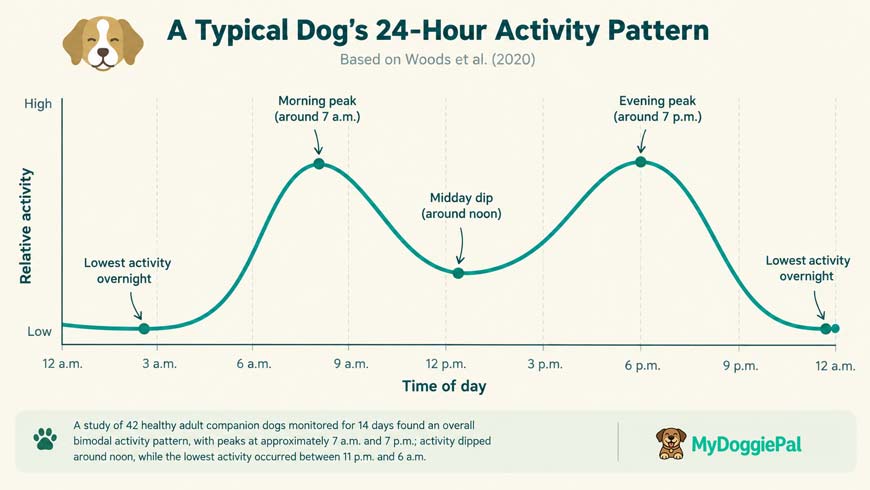
Dogs have a roughly 24-hour body clock, set mainly by light. Research shows pet dogs are mostly active during the day, with peaks around 7 a.m. and 7 p.m. They sleep in many short bouts and largely adapt to their owner’s routine.
What Is a Dog’s Circadian Rhythm?
The Body Clock in Plain English
Deep in your dog’s brain sits a tiny cluster of cells called the suprachiasmatic nucleus. Think of it as a master clock. It runs on a cycle of roughly 24 hours and tells the body when to feel sleepy, alert or hungry. It even nudges body temperature and hormones up and down through the day.
The clock doesn’t run perfectly on its own, though. It needs daily signals to stay on time, and light is the strongest one. Meals, walks and your daily routine act as backup cues, which is why a dog fed at 6 p.m. every day starts staring at you at 5:55.
Why Dogs Sleep in Short Bursts
Here’s where dogs and people differ. We tend to sleep in one long block. Dogs don’t.
In a classic study, Adams and Johnson filmed dogs through the night and counted about 23 sleep-wake cycles in just 8 hours. Each cycle lasted around 16 minutes of sleep followed by 5 minutes awake. So if you notice your dog shifting, sighing or getting up for a drink several times a night, that’s completely normal.
Their rhythm still follows a 24-hour pattern. It’s just made of lots of small pieces rather than one big one. Curious what happens inside each of those short sleeps? Learn what happens in each stage of your dog’s sleep.
So when is your dog’s clock set to be most awake?
Are Dogs Diurnal or Nocturnal?

If you’ve ever searched are dogs diurnal or nocturnal, you’ve probably found mixed answers. The research, however, is fairly clear. Pet dogs are mainly diurnal, which means active by day, with two distinct peaks.
In a 2020 study published in Scientific Reports, 42 pet dogs wore activity monitors for two weeks. Their activity peaked around 7 a.m. and 7 p.m., dipped in the middle of the day and hit its lowest point between about 11 p.m. and 6 a.m. An earlier study by Bazzano and colleagues also found a clear daytime activity pattern in dogs.
Even dogs without owners follow a similar pattern. Researchers in India tracked urban free-ranging dogs across more than 5,600 sightings. More than half of the dogs’ activity happened between 9 a.m. and 10:30 p.m., and they stayed active when people were around.
Living alongside humans for thousands of years seems to have pulled dogs onto our timetable.
Why You’ll See Different Answers Online
Some websites call dogs crepuscular, meaning most active at dawn and dusk. Others say diurnal, or “neither.”
The confusion makes sense.
Dogs’ wild relatives are often busiest at dawn and dusk, and pet dogs still show those morning and evening peaks. But they’re also awake and engaged for much of the day, so diurnal with crepuscular-style peaks is the most accurate answer.
| Pattern | Most active | Example | Dogs? |
|---|---|---|---|
| Diurnal | Daytime | Humans | Mostly, yes |
| Nocturnal | Night | Owls, raccoons | No |
| Crepuscular | Dawn and dusk | Rabbits, deer | Partly (morning and evening peaks) |
Dogs are also well built for dim light. Their eyes have more light-sensitive rod cells than ours, plus a reflective layer called the tapetum that boosts night vision.
That helps explain why dusk walks feel so exciting, and why the famous evening zoomies often hit right around that 7 p.m. peak.
So what tells your dog’s body that it’s time to sleep?
How Light and Melatonin Shape Your Dog’s Sleep
What Melatonin Does
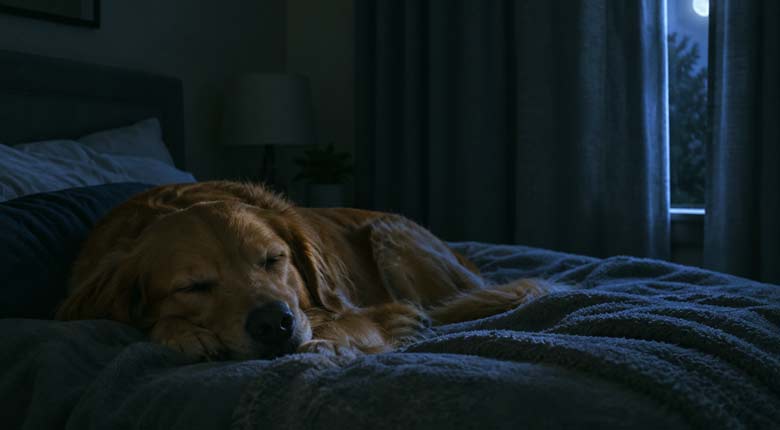
Melatonin is a hormone made mainly by the pineal gland in the brain. It rises in darkness and falls in light, acting like the body’s “it’s nighttime” message.
Dogs definitely have this system. A 1994 study found a clear daily rhythm of dog melatonin production, with levels peaking late in the night. The researchers also found melatonin receptors in key areas of the dog’s brain, including the region that houses the master clock.
Why the Seasons Matter
Melatonin doesn’t stay the same all year. When Zań and colleagues measured melatonin in dogs across four seasons, levels were higher at night than during the day, and the difference was clearest in fall and winter.
That may help explain why some dogs seem sleepier when the days get shorter. It was a small study of just six dogs, so I’d treat it as an interesting clue rather than proof. Still, it fits what many owners notice on dark winter evenings.
Modern Lighting and Your Dog
Your dog’s ancestors only had the sun and moon. Today, bright bulbs and screens can blur the line between day and night. A few small habits support a healthy light and dog sleep cycle:
- Get some daylight on the first walk of the morning
- Dim the lights in the last hour before bed
- Keep the sleeping area dark and quiet
- Use low light for nighttime bathroom breaks
Wondering if your dog needs total darkness? Find out whether your dog should sleep in the dark.
Light isn’t the only thing setting your dog’s clock, though. You are too.
Do Dogs Follow Their Owner’s Sleep Schedule?
So, do dogs follow owner sleep schedule patterns? Largely, yes, and the research on this is fascinating.
A 2025 University of Toronto study tracked dogs through a daylight saving time change. Sled dogs, whose days are tied to sunrise, started moving about an hour earlier the next morning and got back on track within a day.
Pet dogs, on the other hand, showed no clear shift at all, even though their owners felt their dogs were waking early. Pet dogs seem to follow us more than the clock.
Other studies back this up. In the Scientific Reports study, dogs were more active during the day on weekends than on weekdays, which the researchers linked to their owners’ routines.
And a 2024 study found that companion dogs matched their movements to their owners, while dogs and wolves living in packs didn’t.
In other words, your wake-up time, walks, meals and bedtime are some of the strongest clock-setters your dog has. If you live somewhere the clocks change twice a year, here’s how to help your dog adjust when the clocks change.
It works the other way too.
Dogs of night-shift workers often shift their whole rhythm to match. If that sounds like your home, learn how to manage your dog’s sleep when you work nights.
Your dog’s clock also changes with age, lifestyle and health.
How Age, Lifestyle and Health Affect the Body Clock
Puppies, Adults and Seniors
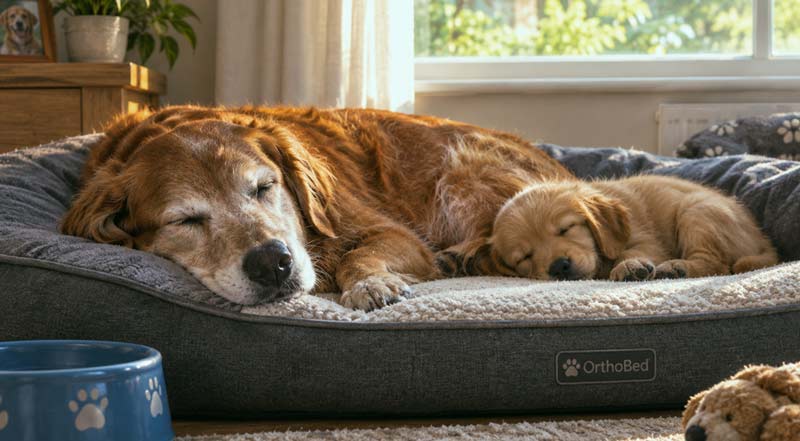
Puppies have a body clock that’s still developing. They need lots of sleep in very short cycles, and they learn the household rhythm from your routine.
Adult dogs usually have the steadiest rhythm. In the Scientific Reports study, younger dogs were noticeably more active during the morning and evening peaks.
Senior dogs often see their rhythm weaken. They may tire earlier in the evening, nap more during the day and wake more at night. Some of that is normal aging.
Watch for this: nighttime pacing, confusion or swapping day for night can be signs of canine cognitive dysfunction, sometimes called dog dementia. If you notice these changes, talk to your vet.
Indoor vs Outdoor Living
Where your dog lives matters too. Research from the University of the Balearic Islands compared dogs living outdoors with dogs living indoors with their owners. Outdoor dogs were more active overall, but their rhythms were more disrupted and less stable. Indoor dogs, meanwhile, mostly followed their owner’s day-night pattern. Life alongside people seems to keep a dog’s clock steady.
Pain and the Body Clock
The same research looked at older dogs with mobility problems. After physical rehabilitation eased their pain, their daily rhythms became more stable and their sleep efficiency improved. So if an older dog’s nights suddenly fall apart, pain is worth ruling out with your vet.
How to Support a Healthy Sleep-Wake Cycle

Signs the Body Clock Is Out of Sync
An off-track clock usually shows up as restless nights, sleeping most of the day, waking very early or being wired late in the evening. A sudden change in your dog’s usual pattern is also worth noticing, especially in older dogs.
Simple Ways to Keep It on Track
A healthy dog sleep wake cycle comes down to rhythm and routine:
- Keep wake-up and bedtime roughly the same, weekends included
- Get morning daylight on the first walk
- Feed meals at regular times
- Use the early-evening energy peak for play, then wind down
- Dim the lights in the last hour before bed
- Make big changes, like new work shifts, in small steps
My advice? Consistency matters far more than the exact times you choose. And please don’t give melatonin to “reset” your dog’s clock without your vet’s guidance.
Dog Circadian Rhythm FAQs
Why does my dog wake me up so early?
Dogs’ activity naturally peaks around dawn, and they quickly learn when breakfast arrives. Keeping a steady routine and moving breakfast later in small steps can gradually shift their wake-up time.
Should I leave a light on for my dog at night?
Most dogs sleep best in the dark. A dim night light is fine for nervous or senior dogs.
Do dogs sleep more in winter?
Some do. Shorter days, longer nights and higher nighttime melatonin may all play a part.
Can I give my dog melatonin for sleep?
Your dog’s natural dog melatonin production usually does the job. Only give a supplement if your vet recommends it and sets the dose, because some human products contain ingredients that are unsafe for dogs.
Final Thoughts
Your dog circadian rhythm is a 24-hour clock set by light and shaped by you. Dogs are mostly day-active, with lively mornings and evenings, and they happily sync with their owner’s routine.
Keep days bright, evenings calm and schedules steady.
When is your dog at their liveliest?
For more, explore our complete guide to dog sleep