

Yes, it does. What your dog eats affects how easily they fall asleep, how deeply they rest, and how settled they are overnight. But the connection runs deeper than most owners realize.
It is not just about choosing a “healthy” food. It is about the specific nutrients that drive sleep chemistry, when you feed, and how well your dog’s gut handles what you give them. This guide covers all three, plus some things the rest of the internet on this topic completely skips.
Does Dog Food Affect Sleep?
The short answer is yes, and through at least three distinct pathways.
First, the nutritional content of food directly influences the neurochemistry behind sleep. Specific amino acids, vitamins, and minerals are the raw materials your dog’s body uses to produce the hormones and neurotransmitters that control sleep onset and sleep depth.
Second, the timing of meals acts as a circadian signal. Your dog’s body uses consistent mealtimes to anchor its internal clock, much the same way light and dark do.
Third, digestibility matters. A dog whose gut is working hard overnight, or is uncomfortable from something that did not agree with them, simply cannot settle into the deep rest they need.
None of this is dramatic. No single food is a sleep cure. But consistent, well-timed, easily digestible meals produce measurably better nights than irregular, heavy, or poorly tolerated ones.
And it works in both directions: the wrong diet can actively disrupt sleep, even in dogs with no other health issues.
Let’s start with the nutrient that has the most direct link to sleep.
Tryptophan and Dog Sleep: The Nutrient-Sleep Connection
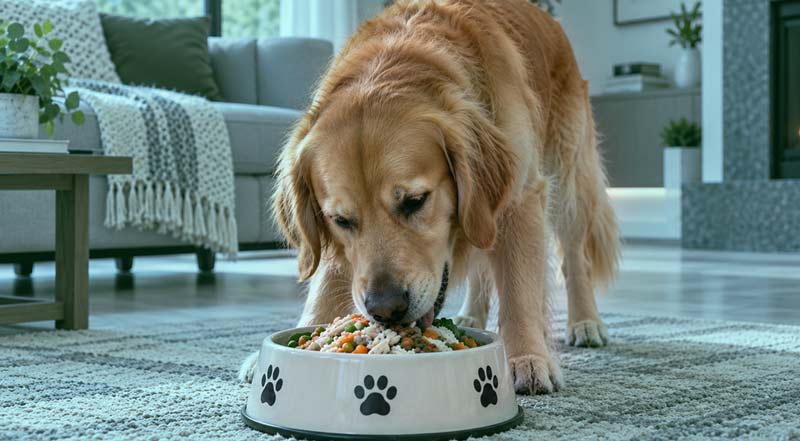
If there is one nutritional word worth understanding in the context of dog sleep, it is tryptophan.
Tryptophan is an essential amino acid. Your dog’s body cannot make it. It has to come from food. Once absorbed, tryptophan converts to serotonin, the neurotransmitter that regulates mood, calm, and the sleep-wake cycle. Serotonin then converts to melatonin, the hormone that signals to the brain that it is time to sleep.
More dietary tryptophan means more serotonin availability, which means better melatonin production, which means more consistent sleep onset and deeper rest overnight.
According to Bonza’s veterinary nutrition guidance, L-tryptophan is the essential biochemical precursor to both serotonin and melatonin in dogs, with the benefits most pronounced in senior dogs and those with sleep disturbances.
Natural food sources of tryptophan include:
- Turkey and chicken, especially dark meat
- Eggs
- Salmon and other oily fish
- Cottage cheese
- Pumpkin seeds
The Competition Problem: Why High Protein Alone Is Not Enough
Here is the part most people never hear. Tryptophan does not just need to be present in food. It needs to reach the brain.
To do that, it has to cross the blood-brain barrier. And it competes with several other large amino acids to do so. In a very high-protein meal, many amino acids flood the bloodstream together.
Tryptophan is one of the least abundant of them. At the transport crossing into the brain, the competing amino acids crowd it out.
The result: A very high-protein meal can paradoxically reduce how much tryptophan actually reaches the brain. Your dog may be eating plenty of tryptophan-rich protein and still not getting the full sleep benefit.
What helps is a small amount of complex carbohydrate alongside the protein. Carbohydrates trigger an insulin response that clears competing amino acids from the bloodstream, leaving tryptophan with a clearer path to the brain.
This is the same reason the Thanksgiving drowsiness effect in humans is about the bread and stuffing alongside the turkey, not the turkey alone.
Practical takeaway: a tryptophan-rich protein paired with a small amount of complex carbohydrate delivers better brain uptake than either on its own. Keep that in mind when we get to evening feeding. First, here is what other nutrients matter.
Best Food for Dog Sleep: What Nutrients Matter

Tryptophan gets all the attention, but it is not working alone. Several other nutrients either support or disrupt your dog’s ability to sleep well.
Nutrients That Support Sleep
Magnesium supports muscle relaxation and nervous system regulation. A deficiency is linked to restlessness and disrupted sleep across mammals. You will find it in green vegetables, whole grains, and some meat sources.
B vitamins, especially B6, are essential for the tryptophan-to-serotonin conversion step. A diet low in B6 impairs this conversion regardless of how much tryptophan your dog eats. It is a hidden bottleneck.
Calcium is involved in melatonin regulation. Low calcium is associated with disrupted sleep in mammals, and the same mechanism exists in dogs.
Omega-3 fatty acids, particularly DHA, support brain function and sleep-wake cycle regulation. The richest sources are oily fish: salmon, sardines, and mackerel.
Nutrients and Ingredients That Disrupt Sleep
Excess simple carbohydrates produce blood sugar spikes followed by crashes. That energy rollercoaster contributes to restless, fragmented sleep, particularly in the second half of the night.
Artificial additives and colorings: some dogs show behavioral sensitivity to certain additives, and that restlessness does not always stop at bedtime.
Theobromine and caffeine from chocolate, coffee grounds, or tea are obvious sleep disruptors. Most owners would not feed these deliberately, but accidental ingestion is more common than people think.
Does Food Format Matter? Wet vs Dry vs Raw
| Food Format | Sleep-Relevant Factors | Notes |
|---|---|---|
| Wet / canned | Higher moisture, more digestible, lower glycemic impact | Reduces overnight thirst and toilet waking |
| Dry kibble | Lower moisture, variable digestibility, often higher carbohydrate content | Can increase overnight thirst; GI impact depends on recipe quality |
| Raw | High protein bioavailability, low glycemic impact, higher moisture | Preparation hygiene matters; quality varies widely between products |
Within each format, ingredient quality matters more than the format itself.
A well-formulated kibble will outperform a poorly sourced raw diet, and vice versa.
What to look for in any format: named protein sources, digestible ingredients, minimal artificial additives, and appropriate carbohydrate levels. With that foundation in place, when you feed becomes just as important as what you feed.
Dog Eating Before Bed: How Meal Timing Affects Sleep

Two separate things happen when your dog eats. One is digestion. The other is a signal to the body’s internal clock. Both matter for sleep.
The Digestive Burden
A large meal close to bedtime puts the digestive system to work during what should be rest time. Blood flow redirects to the gut. Core body temperature rises slightly. The nervous system stays in a more active state.
This delays sleep onset and tends to produce lighter, more fragmented sleep in the early part of the night. The general guideline: the last large meal should finish at least 2 to 3 hours before your dog’s expected sleep time.
The Circadian Signal
Meal timing is one of the primary cues the body uses to set and maintain its internal clock, alongside light and dark cycles. Consistent, predictable mealtimes each day help anchor the circadian rhythm and support a more reliable sleep-wake pattern.
Dogs fed at irregular times often show more variable sleep patterns. Those on a consistent schedule tend to settle more predictably at night. The 2024 Nutrients gut microbiome review by Sejbuk et al. confirmed that meal timing and spacing significantly affect the microbiota’s capacity to produce sleep-regulating metabolites, including serotonin and melatonin.
The Evening Snack: How to Do It Right
A small snack given 1 to 2 hours before bed can actually support sleep onset in some dogs. But the composition matters as much as the timing.
The most effective pre-sleep snack combines a tryptophan-rich protein with a small amount of complex carbohydrate. A little chicken or cottage cheese alongside a piece of sweet potato, for example.
This is not arbitrary, because the carbohydrate component triggers a mild insulin response that clears competing amino acids from the bloodstream, giving tryptophan clearer passage to the brain. Protein alone does not produce this clearing effect.
Keep it small. A full meal at this hour creates a digestive burden that delays rest rather than encouraging it. Think of it as nutritional support for sleep, not a second dinner.
Dog Digestive Issues and Sleep: When the Gut Disrupts the Night
This is the connection most owners miss. And it is one of the most common causes of unexplained sleep disruption.
A dog experiencing GI discomfort, whether from bloating, nausea, cramping, excess gas, or urgency, cannot settle into deep slow-wave sleep.
Discomfort activates the sympathetic nervous system, raising cortisol and preventing the calm parasympathetic state the body needs for real rest.
The signs are recognizable once you know what to look for: repeated repositioning, getting up and lying back down, an inability to settle, or consistent early-morning waking between 2 and 4am followed by urgently needing to go outside.
Any of those patterns is worth looking at through a dietary lens.
QUICK TIP – SIGNS GI ISSUES ARE DISRUPTING SLEEP
Watch for these overnight patterns:
Waking overnight to eat grass in the garden
Early morning restlessness (2am to 4am) followed by urgent need to go outside
Noticeably better sleep on days without treats or table scraps
Why Owners So Often Miss the Link
Here is a distinction that matters. A true food allergy is immune-mediated and usually produces obvious, recognizable symptoms. A food sensitivity is different. It is non-immune, dose-dependent, and often delayed by several hours.
A dog that ate chicken at 5pm and woke unsettled at 2am is not an obvious case of diet-disrupted sleep to most owners. The hours between the meal and the waking break the visible connection.
If your dog consistently wakes overnight and you have not ruled out digestive sensitivity, it is worth discussing a dietary elimination trial with your vet. According to PetMD’s guide to food sensitivities, delayed-onset reactions are common and frequently go undiagnosed precisely because the timing does not feel connected.
Common dietary triggers of overnight GI disruption:
- Ingredients the dog tolerates poorly, even without a formal allergy diagnosis
- Sudden dietary changes that disrupt the gut microbiome
- Heavy or rich treats given in the evening
- Table scraps close to bedtime
- Overfeeding at the evening meal
For a broader look at what disrupts dog sleep beyond diet, see our guide on common dog sleep problems
Diet Quality, the Gut Microbiome, and Sleep Depth
Most people think of serotonin as a brain chemical. The truth is more surprising.
RESEARCH SPOTLIGHT: THE GUT IS YOUR DOG’S SEROTONIN FACTORY
Approximately 90% of the body’s serotonin is produced in the gut, not the brain.
This means gut health is not just indirectly connected to sleep. The gut is the primary site where the chemistry of sleep is built. A dog with a chronically disrupted gut microbiome may be producing significantly less serotonin than a dog with a healthy, diverse one, regardless of what tryptophan is in their diet.
A 2024 peer-reviewed review in Nutrients (Sejbuk et al.) confirmed that dietary fiber, unsaturated fatty acids, and polyphenols all affect the microbiota’s capacity to produce sleep-regulating metabolites including serotonin, melatonin, and GABA.
Diet quality is the primary driver of gut microbiome health. High-fiber whole foods, quality proteins, and prebiotic or probiotic-containing ingredients support a diverse, balanced microbiome.
Heavily processed diets with low fiber and high refined carbohydrates tend to reduce microbiome diversity over time.
The same research also identified GABA (gamma-aminobutyric acid) as another gut-produced sleep-regulating neurotransmitter. GABA is the brain’s primary calming signal, directly involved in producing the relaxed state that precedes sleep onset.
Certain gut bacteria produce GABA as a metabolite, and diet shapes which bacteria dominate your dog’s microbiome.
In practical terms: a dog eating varied, high-quality food rich in protein and fiber is not just supporting digestive health. They are supporting the neurochemical environment that makes better sleep possible. Now let’s put this all together into something you can actually act on.
Practical Diet Changes That Can Improve Your Dog’s Sleep
You don’t need a complete dietary overhaul. These are targeted changes that address the mechanisms covered above.
- Feed consistently timed meals every day, especially the evening meal. Consistent timing anchors the circadian rhythm.
- Ensure the evening meal finishes at least 2 to 3 hours before your dog’s expected sleep time.
- Choose protein sources naturally rich in tryptophan: turkey, chicken, eggs, salmon.
- Pair tryptophan-rich protein with a small amount of complex carbohydrate for better brain delivery of tryptophan.
- Avoid high-GI, carbohydrate-dense foods as the primary evening meal component.
- Minimize or eliminate table scraps and rich treats in the evening.
- Consider a small protein-and-carb snack 1 to 2 hours before bed if your dog is a poor settler.
- If digestive sensitivity is suspected, discuss a dietary elimination trial with your vet.
- Support gut microbiome health with whole-food fiber sources such as pumpkin, sweet potato, or green vegetables, or a vet-recommended probiotic.
Combine these dietary changes with an optimized sleep space and the difference is even more noticeable. Our dog sleep environment guide covers the setup in detail.
The Bottom Line
Your dog’s diet and sleep are connected through real biology: the tryptophan-to-melatonin chain, the gut as the body’s primary serotonin factory, and digestive health as the foundation of overnight rest.
No single food is a sleep cure. But well-timed, high-quality meals that support gut health do create better conditions for rest. Start with consistency, add tryptophan-rich proteins, and pair them smartly.
For everything else about how your dog sleeps, our complete sleep behavior guide is the place to start.