
Yes, exercise to help dog sleep works, but not in the simple way most owners assume.
Too little exercise and too much, or badly timed, exercise can produce the exact same restless symptom, just from opposite causes. This guide covers how much and when, the mental stimulation piece most owners skip, a safety detail nobody mentions, and what to do with a dog that’s tired but still wired.
Does Exercise Help Dogs Sleep Better?
Yes, and the mechanism is well understood. Physical activity increases the body’s drive for deep, restorative slow-wave sleep, an effect confirmed in both human and dog sleep research. This is the basis for the common idea that a tired dog sleeps better.
That idea is broadly true, but the relationship is not a straight line.
Here’s the part most advice skips: too little exercise and too much exercise produce the exact same symptom. Both leave a dog restless and unable to settle, just from opposite causes.
Under-exercised dogs are restless from pent-up, unspent energy. Over-exercised or wrongly-timed dogs are restless from an overstimulated nervous system that hasn’t had time to come back down. This is why “just exercise them more” sometimes makes things worse, not better.
Exercise also helps regulate cortisol and supports a more predictable sleep-wake rhythm, especially when done at consistent times each day. According to Dr. Liza Cahn, quoted by A-Z Animals, physical activity reinforces a dog’s circadian rhythm by distinguishing between active and rest periods, which helps establish a more reliable sleep schedule.
Exercise to Help Dog Sleep: How Much Is Right for Your Dog
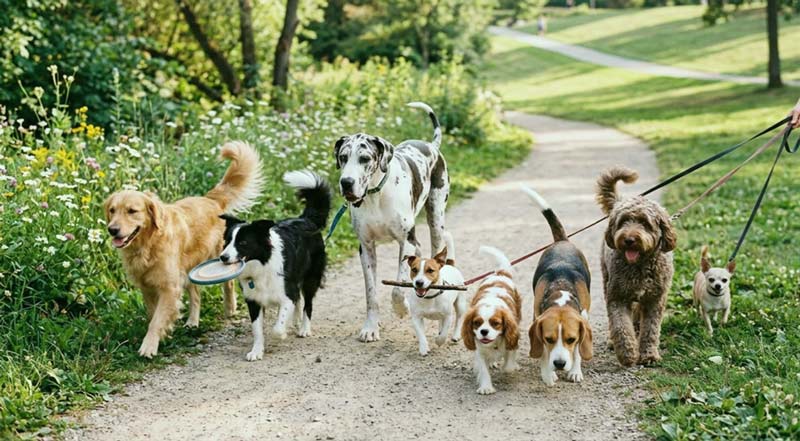
Exercise needs vary significantly by breed, age, and energy level. There is no single universal number, but general reference ranges help.
| Dog Type | Daily Exercise | Mental Balance | Notes |
|---|---|---|---|
| High-energy working/herding (Border Collie, Malinois, GSD) | 60 - 120 min | High mental need | Bred for problem-solving and task focus, not just stamina |
| Medium-energy (Labrador, Spaniel types) | 45 - 90 min | Balanced mix | Mix of walks, play, and some puzzle or training work |
| Low-energy or brachycephalic (Bulldog, Pug) | 20 - 40 min | Lower overall need | Shorter, gentler sessions; avoid overheating |
| Senior dogs | 20 - 40 min | Lean toward mental | Shorter, more frequent sessions over one long one |
| Puppies | Short, frequent bursts | Mental builds focus early | 5 minutes per month of age, not adult totals |
These are general guidelines, not prescriptions. Individual dogs vary, and health conditions should always take priority over generic targets.
Notice the mental balance column. Working and herding breeds are bred for problem-solving and task focus, not just stamina.
For these dogs, simply adding more physical exercise often isn’t enough. They need a higher proportion of mental work to actually settle well at night.
How Much Exercise Before Bed for a Dog? Getting the Timing Right
This is the piece most owners get wrong, and it’s the reason “tire them out” advice sometimes backfires.
The core rule: avoid vigorous exercise within roughly 2 hours of bedtime. Intense activity raises adrenaline, heart rate, and core body temperature, all of which work against the body’s ability to wind down.
A 2-hour buffer gives adrenaline and body temperature time to return to baseline before settling.
A REAL SAFETY NOTE: EXERCISE AND MEALTIME DON’T MIX
Avoid vigorous exercise, especially fetch, running, or rough play, within 1 to 2 hours of a meal in either direction.
Exercising on a full stomach can, in rare cases, cause gastric dilatation-volvulus (bloat): a twisted stomach that is a life-threatening emergency.
This risk is highest in large, deep-chested breeds like German Shepherds, Great Danes, and Standard Poodles, but the precaution is worth following for any dog.
Keep mealtime, exercise time, and bedtime spaced apart rather than stacked together.
What works better close to bedtime:
- A calm, slow sniff walk rather than a fast-paced or high-intensity one
- Low-key activities: gentle play, chew time, or quiet settling routines
- Saving higher-intensity exercise for earlier in the day, ideally morning or mid-afternoon
The timing of the day’s last exercise session also affects evening water needs. A dog exercised right before bed will likely be thirstier overnight, which can mean more toilet trips, so factor hydration into the wind-down window, not just activity level.
Front-loading higher energy activity earlier in the day and tapering to calmer activity in the evening mirrors a more natural rest-activity cycle.
Pairing the right exercise timing with the right sleep environment makes the biggest difference. See our dog sleep environment guide.
Mental Exercise and Dog Sleep: Why Tired Isn’t Just Physical
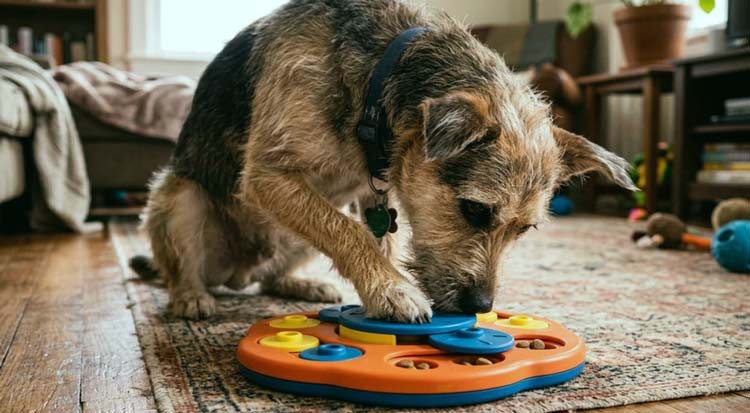
Physical tiredness is only half the picture. Mental fatigue is just as important, and often more efficient.
Sustained problem-solving, decision-making, and scent tracking are metabolically expensive for the brain in a way that’s disproportionate to the physical effort involved.
A dog working through a puzzle feeder or following a complex scent trail is burning real mental energy, not just standing still.
This is why a 15-minute sniff walk or puzzle feeder session can produce a level of tiredness comparable to a much longer physical walk.
The brain is doing sustained, effortful work, and that work is genuinely depleting. According to PetMD, mental exercise can actually tire dogs out more than physical exercise alone, especially in high-energy working breeds.
Practical mental stimulation options:
- Sniff walks: slow-paced walks where the dog is allowed to explore scent freely, rather than walking briskly on a fixed route
- Puzzle feeders and food-dispensing toys
- Short training sessions: 5 to 10 minutes of focused obedience or trick work
- Scent games: hiding treats around a room or yard for the dog to find
Combining moderate physical activity with genuine mental work tends to produce better sleep outcomes than physical exercise alone, especially for high-energy or working breeds. For a full library of mental stimulation activities, see our mental stimulation guide.
Dog Too Excited to Sleep After a Walk: The Tired Body, Wired Brain Problem
This is the over-exercise and wrong-timing side of the pattern from Section 1, and it deserves its own explanation.
A dog can be physically depleted while still being mentally and emotionally aroused. These are not the same state. Physical fatigue alone does not guarantee a calm nervous system.
High-arousal exercise such as fetch, chase, or dog-park play can drain the body’s energy reserves while leaving the brain’s stress and alert systems still switched on.
Common causes:
- The walk itself was high-arousal: lots of other dogs, exciting smells, or play that spiked adrenaline rather than producing calm physical tiredness
- The walk happened too close to bedtime, without enough buffer time for the body to come back down
- The walk was purely physical with no mental component, leaving the brain still switched on even though the body is tired
- The post-walk routine jumps straight into high-energy activity rather than a wind-down period
What helps:
- Add a 20 to 30 minute buffer of calm activity between the walk and bedtime
- End walks with a few minutes of calm sniffing or a slow final stretch rather than finishing on a sprint or chase
- Consider whether the walk route or timing is overstimulating, such as busy streets or peak dog-park hours, and adjust if needed
A Simple Daily Rhythm That Supports Better Sleep
Here’s a sample structure. Adjust the timing to fit your own schedule.
- Morning: higher-energy physical exercise (walk, run, fetch), away from mealtime
- Midday: moderate activity or a second walk if needed
- Afternoon: mental stimulation (puzzle feeder, training session, sniff walk)
- Early evening: calm activity only, no high-intensity exercise, kept clear of dinnertime
- 1 to 2 hours before bed: wind-down period, quiet settling, no vigorous play
This isn’t a rigid prescription. It’s a rhythm: energy out earlier, calm and mentally engaging activities later, mealtimes and exercise kept apart, consistent timing day to day.
If you’ve adjusted exercise and timing and sleep still isn’t improving, see our guide on dog sleep problems for other possible causes.
The Bottom Line
Yes, exercise to help dog sleep really works, but too little and too much both cause restlessness, just for opposite reasons.The right type, the right timing, and a genuine mental workout matter more than raw quantity.
For everything about dog sleep in one place, visit our complete guide to dog sleep.