

Most dog sleep advice assumes your dog can see and hear.
For sensory-impaired dogs, that advice misses the point entirely.
Whether your dog was born blind or deaf, or lost those senses gradually – their relationship with sleep is different. They startle differently. They disorient differently. And the way you set up their environment and wake them matters far more than most owners realize.
This guide covers everything: why sleep changes, how to wake safely, what to set up, and what to do when things go wrong at 3am.
How Sensory Loss Changes the Way Dogs Sleep
Most people assume a deaf dog sleeps more peacefully – no noises to disturb them. And a blind dog just needs a familiar space. Simple enough.
It is not that simple.
Blind dogs lose something most owners never think about: their day/night signal.
Light entering the eyes is what anchors the circadian rhythm (the internal clock that tells the brain when to sleep and when to wake). Remove that light input and the clock starts to drift.
Some blind dogs, particularly those with acquired blindness, begin waking at night and sleeping through the day. Not because they are anxious but because they genuinely do not know it is night.
This same mechanism is well-documented in blind humans. It is called non-24-hour sleep-wake disorder, and veterinary behaviorists are increasingly recognizing a parallel effect in dogs.
Deaf dogs face a different problem.
They cannot hear the environment settle at night. Most dogs track safety through ambient sound like the house going quiet, familiar sounds at regular times, no sudden alarms. Deaf dogs lose that monitoring channel entirely.
Sleep feels less anchored and many compensate by sleeping more lightly, or by pressing against a wall or floor to feel vibrations instead.
Dogs who are both blind and deaf are working with touch and scent only. Every other input that helps a dog feel safe during sleep is gone.
Here is what this looks like in practice:
| . | Blind only | Deaf only | Blind + deaf |
|---|---|---|---|
| Primary sleep impact | Circadian drift; night wandering | Hypervigilance; startle waking | Full sensory isolation during sleep |
| Biggest night risk | Disorientation on waking | Snap reflex when touched | Cannot self-orient after waking |
| Settles how fast | Weeks to months (adult-onset) | Quickly with routine | Slowest (needs the most setup) |
One more thing worth knowing. Dogs born blind or deaf adapt naturally, sleep is rarely disrupted from their baseline. But dogs who lose their senses as adults go through a genuine disorientation period.
Sleep is usually the first thing that breaks. Expect weeks one through four to be the hardest. Most dogs stabilize between months two and three with the right setup.
That setup starts with how you wake them.
How to Wake a Blind or Deaf Dog Without Startling Them
This is the question is mostly searched by impaired dog owners but most answers get it half right.
They tell you to use vibration or blow near the nose. They tell you to touch the shoulder, not the face. Good advice, but incomplete.
Here is what they leave out.
THE SNAP REFLEX – WHAT EVERY FAMILY NEEDS TO KNOW
A startled sensory-impaired dog can snap or bite. This is not aggression but a pure survival reflex. The dog wakes in fight-or-flight with no information about what just touched them. It will happen again unless the waking technique changes.
Children should never wake a blind or deaf dog without an adult present. Teach this rule before it becomes a problem.
Waking a Deaf Dog
- Stay in their sightline: if they have any vision, never approach from behind
- Vibration first: tap the floor firmly near them, or place your hand on the surface beside them. Let them feel something before they see or smell you
- Wait: a small ear twitch or body shift means they have registered something
- Hand near the nose: let them smell you before any touch
- Touch the shoulder or back: never the face, never the tail
- Reward immediately: treat or calm praise, every single time. Waking becomes something good
Waking a Blind Dog
- Voice first, always: a consistent phrase (“wake up, [name]”) in a calm, normal tone
- Same direction every time: approach from the same side consistently. The predictability itself becomes a safety signal
- Wait a beat: give them time to surface before touch
- Shoulder touch: steady, calm, not a tap
- Same routine every time: routine reduces the startle response more than any single technique
If Your Dog Is Both Blind and Deaf
Scent is your only advance signal.
Hold your hand near their nose before any touch. A gentle puff of breath directed at their coat (not the face) can work as a pre-contact cue. Floor vibration still helps. And reward every single wake without exception. Building a positive association with waking is not optional here – it is the whole strategy.
The right environment makes everything above easier.
Let’s build it.
Designing a Sleep Space for a Sensory-Impaired Dog
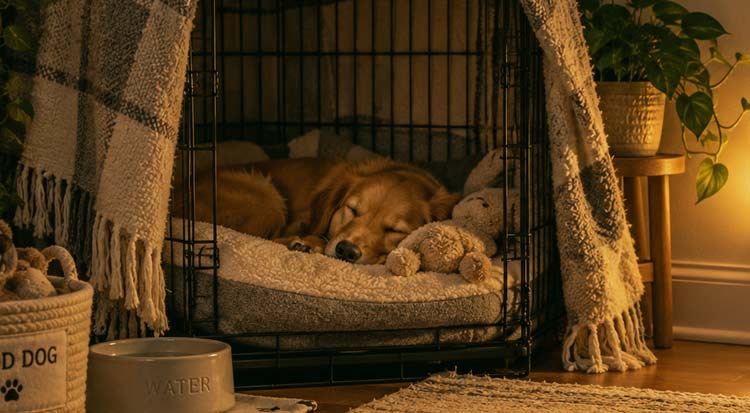
The sleep space does extra work when a dog cannot rely on their senses to orient on waking. Get this right and everything else gets easier.
For Blind Dogs
Scent-map the bed. Use a consistent scent near the sleeping area every night (same spot, same scent). They can find it independently without needing you to guide them.
Lay a tactile path. A distinct rug or mat leading to the bed gives them a texture trail to follow. Simple and effective.
Fix the layout. Never rearrange furniture around their sleep area. Their mental map is built on muscle memory. One moved chair can turn a familiar space into a hazard course.
Replace the lost light signal. Blind dogs need substitute day/night cues. Use a scent you apply only at bedtime (lavender on the bed, nothing else). A consistent “sleep” phrase. The same sequence every night. You are building the signal their eyes can no longer give them.
Nightlight for partially sighted dogs. Even dim light gives a partial-vision dog a meaningful anchor. Pitch dark removes it entirely.
For Deaf Dogs
Give them a sightline. Deaf dogs rely on vision to feel safe. A sleep space facing a wall, or tucked into a corner with no view of the room, removes their remaining monitoring sense.
Work with the vibration instinct. Many deaf dogs sleep pressed against a wall or floor. They are using vibration to track the environment. This is adaptive behavior – do not block it!
Enclose the space. Without sound to orient them, open spaces feel unsafe. A crate or den-style bed with sides gives them boundaries that feel like security.
Keep it away from foot traffic. Deaf dogs feel floor vibrations. A bed in a busy corridor means waking every time someone walks past.
The Safety Angle
A deaf dog cannot hear a smoke alarm. A blind dog cannot navigate to an exit through a rearranged or unfamiliar space.
Vibrating smoke alarm accessories exist that are designed for deaf owners, but equally relevant for deaf dogs sleeping near them. And walk your blind dog through the exit route while calm and awake. Do this regularly so the path is muscle memory, not a problem to solve in an emergency.
Sleep space audit: run through this:
- Bed in the same location every night
- No furniture moved around the sleep area
- Tactile path to bed (rug or mat trail)
- Consistent scent on the bed, used only at sleep
- No raised surfaces or stairs nearby
- Enclosed or semi-enclosed sleep space
- Away from night foot traffic
- Low nightlight if any residual vision
- Consistent bedtime cue every single night
For a full guide on dog sleep environment setup, read our complete sleep environment guide →
Sleep Anxiety in Sensory-Impaired Dogs

Sensory loss and anxiety go together especially in dogs who lost their sight or hearing as adults. It’s simply because they have not had a lifetime to adapt. The disorientation is real, and sleep is where it surfaces most.
Signs to watch for:
- Refusing to sleep alone or refusing to settle at all
- Waking and seeking physical contact repeatedly through the night
- Pacing for long periods before lying down
- Sleeping pressed against walls or wedged under furniture
- Startling awake with no obvious cause
- Night vocalization: deaf dogs especially, because they cannot hear themselves doing it
Should I let my dog sleep in my bed?
Honest answer: it depends.
Your scent and body heat are powerful calming signals, and during the adjustment period after acquired vision or hearing loss, physical proximity genuinely reduces anxiety. But it can also increase dependence and slow the process of building independent confidence.
The better middle ground: a dog bed on the floor right beside yours. Same proximity but less dependence. Your hand can reach them if they wake. They can smell and sense you all night.
What Actually Helps
Scent bonding. A worn T-shirt near the bed is one of the most consistently effective calming tools for sensory-impaired dogs. Your scent is the strongest available safety signal when other senses are gone.
Routine as medicine. Same order, same time, every night. For a dog who has lost their sensory anchors, predictable sequence becomes their compass.
Adaptil pheromone diffuser. Plug it in near the sleep space. Particularly useful during the weeks immediately after acquired impairment when anxiety is highest and everything is new.
Melatonin. Can help re-anchor the circadian rhythm in blind dogs who are drifting off a day/night cycle. Ask your vet about dose and timing before starting.
Touch check-in before you sleep. A deliberate, gentle shoulder touch before you go to sleep signals “I am here, it is safe.” Simple but works.
If anxiety goes beyond the adjustment period and your dog still cannot settle months in, our dog sleep anxiety guide covers the full picture →
The 3am Problem: When Your Dog Won’t Settle at Night
It is 3am, your blind or deaf dog is awake and disoriented. They are wandering, pressing against walls, whining or just standing there looking lost. Nothing you have tried is working.
This is usually one of two things.
Disorientation from sensory loss. They woke and could not re-orient. Without sight or sound to tell them where they are, the familiar room becomes confusing. The anxiety builds.
Canine Cognitive Dysfunction (CCD) often called sundowning. Common in senior dogs and frequently appears alongside sensory loss. Night waking that gets worse over time – not better – is a CCD flag. The approach changes significantly when CCD is involved, and a vet needs to be in that conversation.
The 3am protocol:
- Move slowly: rushing signals alarm. Your energy is contagious
- Signal yourself first: voice if they can hear; floor tap or hand near the nose if they cannot
- Go to them: don’t call them to navigate through the dark on their own
- Guide them back to their sleep space: gently, same route every time
- Sit quietly nearby for five minutes: calm presence breaks the anxiety loop more reliably than any other tool
- No treats, no play, no stimulation: keep it completely boring. Night is night
- Check for pain: a dog who cannot settle may be in discomfort, not just disoriented. If this is new behavior, call your vet
From one owner. My border terrier Oscar went blind at 11. The first three weeks he woke every night between 2 and 4am confused, pressing against walls, making sounds I had never heard before. I started sleeping with one hand touching his bed. Lavender only at night. Same bedtime routine in the same order every night. By week six he was waking twice a week. By month three, almost never. The consistency was the treatment. It really does get better.
Is It Working? Signs Your Dog Is Adjusting
Progress after sensory loss is slow and uneven. But it is real. Here is what it actually looks like.
Signs things are improving:
- Settling in under 30 minutes instead of an hour or more
- Fewer night wakings each week
- Going to their sleep space independently without being guided
- Tolerating waking without a strong startle response
- Returning to sleep after a night waking without needing you to intervene
- Normal appetite the next morning (dogs in ongoing anxiety often skip breakfast)
Rough timeline for adult-onset impairment:
- Weeks 1–4: hardest phase. Night waking, disorientation, clinginess are all normal. Hold the routine
- Months 1–3: gradual improvement. Most dogs stabilise with consistent environment and waking practice
- Beyond 3 months: if disruption is still severe or worsening, involve a vet. Rule out pain, CCD, or an anxiety disorder that needs treatment
Worsening over time, not plateauing but actively getting worse – is the key flag. That stops being an impairment management problem and becomes a medical one.
For the full picture on sleep disruption beyond sensory impairment, the dog sleep behaviors guide covers everything →
The Bottom Line
Your dog has lost one or two senses. But they still have you – your scent, your touch, your routine.
That is not a small thing. It is enough to rebuild their sense of safety at night.
Get the environment right. Practice the waking technique before you need it. Hold the routine even on the hard nights. Most dogs adjust within two to three months. And it gets better from there.