

Dog nighttime anxiety is one of the most common and most draining problems dog owners face. And the frustrating part is that it’s not always obvious why your dog can’t settle.
In this guide we’re going to cover exactly what dog sleep anxiety looks like, what causes it, and most importantly what you can actually do about it.
Some fixes will help tonight.
Others take a little longer but make a real difference.
If your dog’s anxiety is severe, sudden, or getting worse, please do speak to your vet. But for most owners, there’s a lot you can try at home first. Let’s start with understanding what you’re dealing with.
👉 For a broader look at your dog’s sleep health, see our complete dog sleep guide.
What Does Dog Sleep Anxiety Look Like?
Before we can fix the problem, we need to know what we’re looking at. Anxious dogs can’t sleep for all sorts of reasons and the signs aren’t always obvious at first.
Behavioral Signs at Bedtime
Watch out for these before your dog even tries to settle:
- Pacing or circling can’t find a comfortable spot and keeps moving
- Whining, crying, or barking vocalising without a clear reason
- Refusing their bed keeps leaving their sleeping spot and coming to find you
- Velcro behaviour glued to your side, won’t let you out of sight
- Excessive yawning or lip licking these are stress signals, not just tiredness
- No appetite in the evening stress suppresses appetite, so a dog that skips their evening meal may be more anxious than hungry
These signals are your dog’s way of saying something doesn’t feel right. The key is learning to read them before things escalate.
Signs During the Night
If your dog is getting you up repeatedly, here’s what to look for:
- Waking frequently and struggling to settle back down
- Destructive behaviour chewing, scratching at doors or skirting boards
- Indoor accidents even in a house-trained dog, anxiety can trigger this
- Trembling or shaking in the night with no obvious cause
- Sleeping heavily during the day but restless at night an inverted sleep cycle can be an early sign of cognitive decline in older dogs
How to Tell Anxiety Apart from a Medical Problem
This is really important. Pain, urinary infections, thyroid issues, and gastrointestinal discomfort can all look exactly like dog sleep anxiety. They’re not the same thing and they need different solutions.
The golden rule: Sudden-onset anxiety always warrants a vet check first.
If your dog was fine last week and is now a mess at night, don’t assume it’s behavioral.
If you also notice changes in appetite, drinking habits, or bathroom frequency alongside the restlessness, book that vet appointment. Don’t wait.
Quick tip: Keep a short log of your dog’s nighttime behavior before your vet visit. Note the time it starts, how long it lasts, and what it looks like. This gives your vet something concrete to work from
Once medical causes are ruled out, we can look at what’s really going on. And that means understanding the causes which is exactly what the next section covers.
What Causes Nighttime Anxiety in Dogs?

Dog nighttime anxiety doesn’t come from nowhere. There’s always a reason even if it’s not immediately obvious. Here are the most common causes.
Separation Anxiety
This is the big one. Many dogs simply cannot settle without being close to their owner. At night, when the house goes quiet and your scent fades from the room, that sense of security disappears and the anxiety kicks in.
It’s worth knowing that true separation anxiety at night is different from general isolation distress. True separation anxiety is specifically triggered by the owner’s absence. Isolation distress is more about being alone, regardless of who’s there.
Senior dogs can be especially vulnerable here. According to the ASPCA, older dogs sometimes experience sleep itself as a form of isolation which can make bedtime genuinely distressing for them.
For a deeper dive into this topic, read our full guide on separation anxiety in dogs.
Not Enough Exercise or Mental Stimulation During the Day
Here’s something a lot of owners miss: a dog that hasn’t been tired out during the day simply cannot wind down at night. Excess physical energy has to go somewhere. If it doesn’t come out on a walk, it comes out at 2am.
And it’s not just physical exercise. Mental stimulation matters just as much. A dog whose brain hasn’t been challenged, no training, no sniff work, no puzzle feeders is going to be buzzing at bedtime.
Working breeds are especially prone to this. A Border Collie or Malinois that’s had one 20-minute walk and a quiet day is not going to sleep well. Full stop!
A tired dog is a calm dog. It really is that simple though putting it into practice takes a bit of planning. We’ll cover the specifics in the solutions section.
Environmental and Sound Triggers
The night is a surprisingly noisy time for a dog. Dog pacing at night is often triggered by sounds we barely notice like foxes outside, a neighbors car, a radiator clicking.
Thunderstorms and fireworks are the obvious culprits. But because everything else is quiet at night, even a muffled sound can feel amplified to a dog with sensitive hearing.
Fear of the dark is also worth mentioning here. Some dogs particularly those with fading eyesight, develop a genuine anxiety around darkness. They lose the visual cues that help them feel safe, and the result is nighttime anxiety that seems to come from nowhere.
A low-level night light near your dog’s sleeping area can make a real difference for these dogs. Simple, cheap, and surprisingly effective.
New or Disrupted Environments
Dogs are creatures of habit. Move the furniture. Change the routine. Bring home a new baby. And suddenly your dog doesn’t know what’s normal anymore.
Rescue dogs adjusting to a new home are particularly vulnerable. The 3-3-3 rule: 3 days to decompress, 3 weeks to learn the routine, 3 months to feel at home applies directly to nighttime settling too. What looks like dog sleep anxiety in a new rescue is often just adjustment. It takes time.
If you’ve just brought a new dog home and they’re struggling at night, our guide on helping a new dog sleep has some immediate steps that can help.
Routine Disruption and Cumulative Stress
This one’s underestimated. Stress doesn’t just appear at bedtime it builds throughout the day.
A dog that’s had a stressful walk, met an unfamiliar person, heard a loud noise, and been left alone longer than usual arrives at bedtime already over-threshold.
This is sometimes called trigger stacking – multiple smaller stressors adding up until the dog’s nervous system is overwhelmed. By bedtime there’s no buffer left. The slightest thing sets them off.
Irregular feeding times, inconsistent walk schedules, and changes in the owner’s routine all contribute. Even seasonal changes shorter days, darker mornings can shift a dog’s internal rhythm enough to cause disruption.
Age-Related Causes Puppies and Senior Dogs
Puppies and senior dogs are the two groups most likely to struggle at night but for very different reasons.
Puppies are missing their littermates, their mother, and everything that felt safe. Their bladders are tiny. They haven’t learned to self-settle yet. Some nighttime distress in a new puppy is completely normal though it still needs managing thoughtfully.
Senior dogs face a different challenge. Canine Cognitive Dysfunction (CCD) sometimes called canine dementia disrupts the sleep-wake cycle directly. You may notice your older dog sleeping more during the day and becoming restless, confused, or vocal at night.
This evening worsening is sometimes called “sundowning” a phenomenon also seen in humans with dementia. Your dog isn’t being difficult. They’re genuinely disorientated.
Add fading eyesight and hearing loss on top of that and you can see why nighttime becomes so much harder for senior dogs. They lose the sensory cues that tell them where they are and that everything is safe.
If you suspect CCD, a vet visit is essential. This isn’t something training alone can fix.
Underlying Anxiety Conditions
Some dogs have generalized anxiety that runs deeper than any single trigger. For these dogs, nighttime is when the anxiety peaks because the distractions of the day are gone and there’s nothing left to focus on except the worry.
Rescue dogs with a history of trauma or poor socialization are particularly likely to fall into this category. For them, anxious dogs can’t sleep isn’t just a nighttime problem, it’s a symptom of something that runs through everything they do.
Professional support is almost always needed for generalized anxiety. Managing the sleep problem alone won’t address the root cause. That said, the strategies in this guide will help reduce the load.
Now that we know why it’s happening let’s talk about what to actually do about it.
How to Calm a Dog With Sleep Anxiety Solutions That Actually Work
There’s no single magic fix for dog sleep anxiety. But there are a lot of practical, evidence-based strategies that genuinely make a difference. We’ll go from immediate actions you can take tonight, right through to longer-term approaches.
Build a Consistent Bedtime Routine
Dogs feel safe when they know what’s coming next. A consistent bedtime routine signals to your dog’s nervous system: this is safe time, this is wind-down time, this is sleep time. Done consistently, it becomes a powerful anxiety reducer.
Here’s a simple routine blueprint that works:
- Exercise at least 2 hours before bed (more on timing below)
- Mental enrichment like a puzzle feeder, sniff session, or short training game
- Final toilet trip is crucial, especially for puppies and older dogs
- Quiet wind-down: 30–60 minutes of low stimulation: calm TV, reading, no rough play
- A consistent bedtime signal such as a word, a treat, a specific action that always means ‘bed time’
- Same sleep location every night: Consistency matters more than perfection
What to avoid: high-energy play right before bed, exciting visitors, or loud TV. You’re trying to lower arousal, not raise it.
A small, consistent evening snack at the same time each night can also serve as a gentle bedtime cue, and a lick-mat or Kong at bed time doubles up as a decompression tool (licking is genuinely calming for dogs at a physiological level).
Exercise and Mental Enrichment During the Day
We touched on this in the causes section and it deserves its own space here because it’s one of the highest-impact changes you can make.
The goal is to arrive at bedtime with a dog who is physically and mentally satisfied. Not exhausted to the point of stress, just genuinely content and ready to rest.
Practical ideas:
- A longer afternoon walk aim for sniff time, not just distance
- A puzzle feeder or Kong for part of their daily food allowance
- A short 5-minute training session in the early evening mental work tires dogs out fast
- Scent games around the garden hide treats, let them use their nose
One important note on timing: avoid high-intensity exercise within 2 hours of bed. Vigorous exercise raises cortisol and adrenaline great for the park, not great right before sleep. Aim for calmer enrichment closer to bedtime.
According to the American Kennel Club, the amount of exercise a dog needs varies significantly by breed, age, and health but most adult dogs need more than they’re getting. If your dog is restless at night, this is the first place to look.
Optimize the Sleep Environment
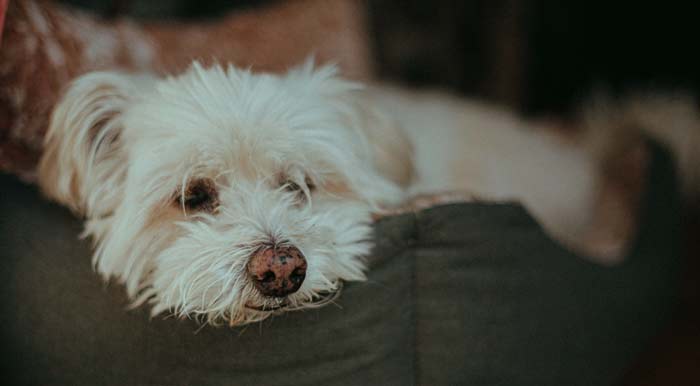
A dog’s sleeping space should feel like a den safe, contained, and predictable. Think covered crate, a corner bed with raised sides, or a deep donut-style bed. Somewhere they can curl up and feel enclosed.
Here’s what makes the biggest difference:
- Temperature not too warm, not too cold. Most dogs sleep best around 65–68°F / 18–20°C
- Darkness management for dogs with fear of the dark or sensory decline, a low night light near their bed can be transformative
- Owner scent place a worn, unwashed t-shirt in their bed. Your scent is genuinely reassuring to them
- Non-slip flooring for senior dogs disorientation at night is made worse by slipping on hard floors
- Consistent location don’t move their bed around. Predictability is the point
For a full breakdown of how to set up your dog’s sleep space, see our guide on creating the perfect sleep environment for your dog.
Crate Training as a Settling Tool Done Right
A crate can be one of the most powerful tools for an anxious dog that can’t sleep or one of the worst. It depends entirely on how it’s introduced.
Never lock a panicking dog in a crate. Full stop. If a dog is already distressed and you force them in, the crate becomes associated with fear. You’ll make things significantly worse.
The right approach is gradual. Start by placing the crate in your bedroom and this gives your dog proximity to you while still having their own space. Then over several weeks, move it slowly toward its permanent location.
- Build the association positively:
- Feed meals in the crate with the door open
- Drop treats inside throughout the day make going in a good thing
- Build up to short periods with the door closed before trying overnight
- Never use the crate as a punishment
Crate training isn’t the right solution for every dog. Some dogs find confinement more distressing, not less. Watch your dog, not a rule book.
Gradual Alone-Time Training for Separation Anxiety
If separation anxiety at night is the root cause, the only long-term fix is helping your dog learn that being apart from you is safe. That takes time but it absolutely can be done.
The principle is simple: start with tiny separations and reward calm settling. Put your dog in their sleeping spot. Step one pace away. Come back. Reward calm. Slowly build distance and duration over days and weeks. Never rush it.
Here’s something really important: comfort your dog when they’re calm and starting to settle, not in the middle of active panic. Rushing in to soothe a dog mid-meltdown can accidentally reinforce the panicking behavior. It’s hard to hold back when they’re distressed. But calm-rewards work better than crisis-comfort.
Severe separation anxiety almost always needs professional support alongside home training. If your dog is destroying things, injuring themselves, or showing no improvement after several weeks, please don’t struggle on alone.
Training Techniques for Nighttime Settling
Beyond routine and environment, there are specific training approaches that help with dog sleep anxiety:
- Settle/mat training: Teach your dog that their bed is a place where good things happen. Feed meals there. Give treats there. Practise sending them to it during the day so it becomes a positive destination, not an exile
- Capturing calmness: Reward quiet, relaxed behavior in the evening, not just at the moment of settling. Every calm moment is worth marking. You’re building a habit of calmness, not just a bedtime behavior
- Lick-mat before bed: The act of licking promotes serotonin release and is physiologically calming. A lick-mat smeared with peanut butter or wet food, given consistently at the same time each night, can become a powerful settling ritual
If your dog’s anxiety is linked to specific triggers, a sound, a sight, another dog outside desensitization and counter-conditioning (DS/CC) is the gold-standard approach. The principle is: change the emotional response first, and behavior follows.
This is a bigger topic than we can fully cover here. Our guide to desensitization and counter-conditioning for anxious dogs has the full breakdown.
A Note on Medication
For some dogs, medication is genuinely part of the answer. That’s nothing to be ashamed of.
For specific trigger nights, fireworks, thunderstorms, situational options like trazodone or gabapentin can help. For chronic, ongoing anxiety, SSRI-based medication (like fluoxetine) may be worth discussing with your vet alongside a behavior program.
Medication is always an adjunct not a standalone fix. A dog whose anxiety is rooted in genuine fear needs training and management as well as medication. The medication reduces the emotional noise enough for the training to work.
Always get medication through your vet or veterinary behaviourist. Don’t self-prescribe.
Calming Products That Can Actually Help
Products are not a cure. But used alongside good training and routine, several can make a real difference. Here’s an honest look at what’s out there:
Pressure wraps (e.g. Thundershirt)
A snug-fitting wrap that applies gentle, constant pressure similar to the effect of swaddling. Works best for sound-triggered anxiety (thunderstorms, fireworks). Doesn’t work for every dog, but it’s low-risk and worth trying as a first step.
Calming pheromone diffusers and sprays (e.g. Adaptil)
Adaptil uses synthetic dog-appeasing pheromone, a chemical message that mimics what mother dogs produce for their puppies. Plug the diffuser in near your dog’s sleeping area and leave it running. Spray the bedding before night time.
The evidence base is modest but consistently positive. Consistent, long-term use matters more than a one-off application.
Calming supplements
Options include melatonin, L-theanine, Zylkene (hydrolyzed milk protein), and valerian. Results vary between individual dogs. Always check with your vet before starting any supplement, especially if your dog is on other medication.
White noise machines and calming music
Masking environmental sound is one of the simplest and most underused strategies. Classical music and species-specific recordings (look up Through a Dog’s Ear) have good supporting evidence. A basic white noise machine works too. Particularly useful for dog pacing at night triggered by outdoor sounds.
Anti-anxiety dog beds
Deep-sided, donut-style beds that mimic the feeling of curling up against a littermate. Low-risk, often effective as part of a wider approach. Not a standalone fix, but genuinely useful.
Remember: products support good training and management. They don’t replace it. For product recommendations and comparisons, see our guide to the best calming aids for dogs
Should Your Dog Sleep in Your Bed? An Honest Answer
This question comes up a lot.
And the honest answer is: there’s no universal right or wrong.
Co-sleeping can genuinely reduce nighttime anxiety for both dog and owner. Research suggests it can lower anxiety and increase feelings of security. For some dogs, proximity to you is the most effective calming tool there is.
That said, there are practical considerations. Dogs with arthritis may struggle getting in and out of bed. If you’re a light sleeper, a fidgety dog will wreck your rest. And if you have allergies, it can make things worse.
The middle ground that often works best: a dog bed on the floor of your bedroom. Your dog gets your scent, your breathing, your presence without the full bed-sharing setup. For many anxious dogs, this alone is enough to transform their sleep.
It’s a personal decision. Don’t let anyone make you feel guilty either way.
When to Get Professional Help

Most dog nighttime anxiety responds to the strategies above. But sometimes it doesn’t and recognizing that point matters.
Consider getting professional support if:
- The anxiety happens every single night and shows no improvement after 4–6 weeks of consistent effort
- Your dog is injuring themselves scratching until bleeding, destroying their way out of a space
- Separation anxiety is severe or escalating this needs a certified clinical animal behaviourist, not just a dog trainer
- Your older dog has developed sudden night anxiety vet first, always, to check for CCD, pain, or sensory loss
Before your appointment, keep a written log of your dog’s nighttime behavior. Note the time it starts, how long it lasts, what it looks like, and any apparent triggers.
This makes your vet’s job much easier and speeds up finding the right solution.
Asking for help is not a failure. It’s the most loving thing you can do for your dog.
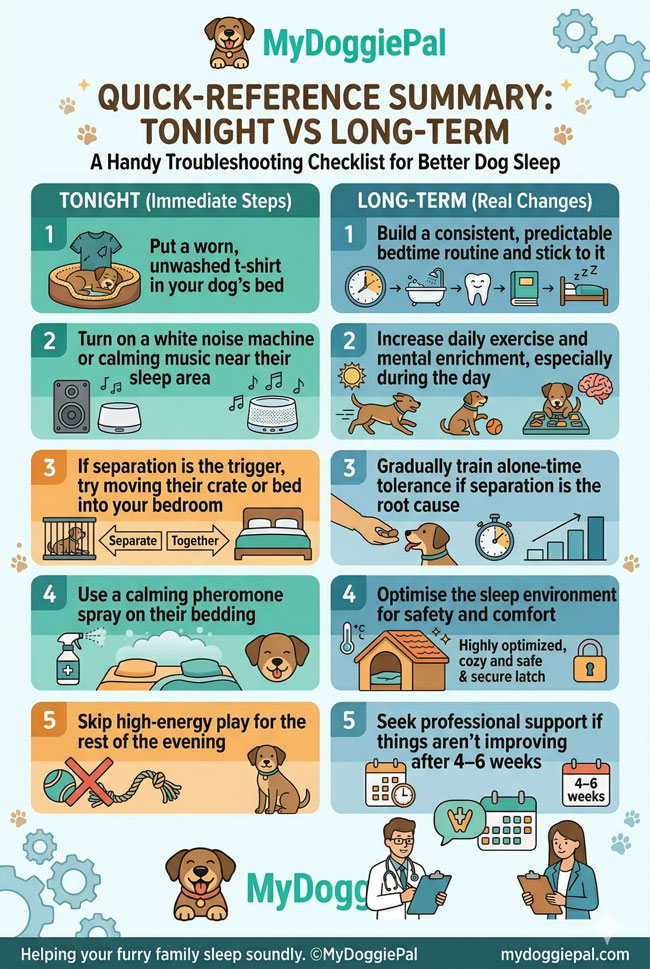
Quick-Reference Summary: Tonight vs Long-Term
Tonight (immediate steps you can take right now)
- Put a worn, unwashed t-shirt in your dog’s bed
- Turn on a white noise machine or calming music near their sleep area
- If separation is the trigger try moving their crate or bed into your bedroom
- Use a calming pheromone spray on their bedding
- Skip high-energy play for the rest of the evening
Long-term (the changes that make the real difference):
- Build a consistent, predictable bedtime routine and stick to it
- Increase daily exercise and mental enrichment especially during the day
- Gradually train alone-time tolerance if separation is the root cause
- Optimise the sleep environment for safety and comfort
- Seek professional support if things aren’t improving after 4–6 weeks
Remember: There’s no overnight fix for dog sleep anxiety. But with patience and consistency, most dogs improve significantly. You’ve got this.
Frequently Asked Questions
Why does my dog only get anxious at night?
During the day, your dog has stimulation, company, and activity to focus on. At night, all of that disappears and whatever anxiety or stress they’re carrying has nothing left to compete with. The quiet, the dark, and your reduced presence all amplify how an anxious dog feels. It’s not that the anxiety only exists at night. It’s that night when there’s nothing else to distract from it.
Should I let my anxious dog sleep in my bed?
This is a personal choice and there’s no rule that says you shouldn’t. Co-sleeping can reduce nighttime anxiety for both of you. The main considerations are practical: your sleep quality, your dog’s physical ability to get in and out of bed, and any allergy concerns. If you’d rather not share your bed, a dog bed on the floor of your bedroom is a great middle ground that provides the proximity your dog needs.
How long does it take to treat dog sleep anxiety?
It depends on the cause and the severity. Environmental tweaks like a white noise machine or a better sleep setup can help within days. Building a consistent routine takes a few weeks to take effect. Separation anxiety training is a longer process, expect several months of gradual work, especially for severe cases. The key is consistency. Sporadic effort produces sporadic results.
Can puppies have sleep anxiety?
Absolutely. Puppies have just left everything familiar – their mother, their littermates, their smells and sounds. Some distress at night is completely normal in the first few weeks. The goal isn’t to eliminate all night waking immediately but to build a positive association with their sleeping space, establish a routine, and gradually extend the periods of calm settling. It gets easier.
Is dog sleep anxiety the same as separation anxiety?
Not always. Separation anxiety at night is one cause of sleep anxiety but not the only one. Your dog might also be anxious because of sounds, a new environment, pain, or cognitive decline. Separation anxiety specifically involves distress triggered by the owner’s absence. If your dog only seems anxious at night when you’re in a different room, separation anxiety is likely a factor. If they’re anxious regardless of where you are, look at other causes.
Do calming treats actually work for dogs at night?
Some dogs respond well to supplements like L-theanine, Zylkene, or melatonin; others see little effect. The honest answer is that the evidence varies. Calming treats work best as part of a wider approach that includes routine, environment, and training. They’re rarely effective on their own. Always check with your vet before starting any supplement, especially if your dog has existing health conditions or is on medication.
Why has my older dog suddenly started being anxious at night?
This is a vet question first. Sudden-onset nighttime anxiety in a senior dog can indicate pain (arthritis, dental disease), Canine Cognitive Dysfunction, sensory decline (hearing or vision loss), or other medical conditions. Don’t assume it’s purely behavioural. Get a vet check before doing anything else. The sooner any underlying condition is identified, the sooner you can help your dog feel better.
Can I comfort my dog when they’re anxious, or will it make it worse?
You can and should comfort your dog but timing matters. Comfort your dog when they are calm or beginning to settle. This rewards the calmer state and encourages more of it. Rushing in to soothe a dog in the middle of active panic can reinforce the panicky behavior, because from your dog’s perspective, panicking is what got your attention. It’s a small distinction but an important one.