
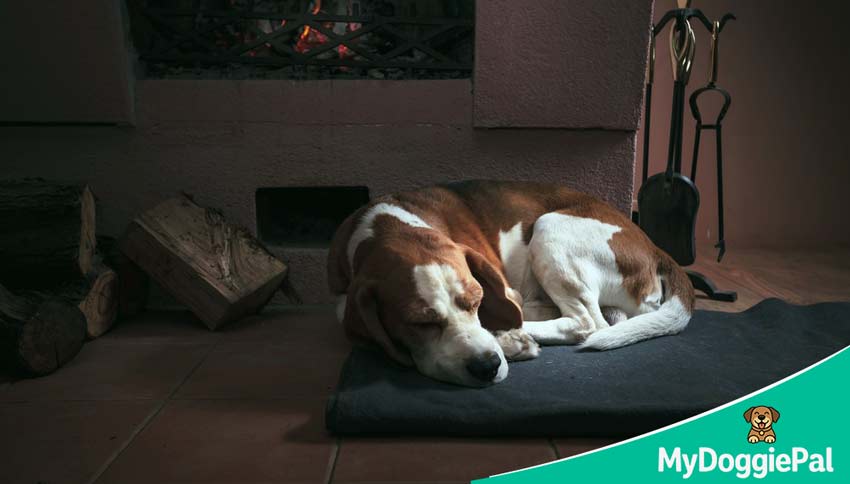
Temperature is one of the most overlooked variables in dog sleep quality. Both extremes disrupt rest, but overheating is the more common problem in most homes.
This guide covers the ideal dog sleep temperature range, how to check at home in under a minute, the humidity factor most owners miss, and practical steps for summer and winter.
What Temperature Do Dogs Sleep Best In?
Start with the concept behind the number.
Dogs have a thermoneutral zone (TNZ): the temperature range within which their body requires no extra effort to maintain core temperature. Inside the TNZ, the dog does not shiver, pant, or seek surfaces. Deep slow-wave sleep is undisturbed by thermal regulation.
Outside the TNZ, the body is doing maintenance work, and that physical effort competes directly with restorative sleep.
This is why getting the dog sleep temperature right is not just about comfort. It determines whether sleep is restorative or just time spent lying down.
The ideal range for most adult dogs is 65 to 75 degrees Fahrenheit (18 to 24 degrees Celsius).
Published figures you will find elsewhere range from 60 to 78 degrees, and they differ because ambient room recommendations, sleep comfort optima, and clinical safety thresholds are three different numbers.
This article uses sleep comfort optima specifically.
| Dog Type | Preferred Sleep Temperature |
|---|---|
| Large, thick-coated breeds (Husky, Malamute, Bernese) | 60 to 68°F (15 to 20°C) - cooler end |
| Small or short-coated breeds (Chihuahua, Greyhound, Whippet) | 70 to 75°F (21 to 24°C) - warmer end |
| Puppies | 72 to 75°F (22 to 24°C) - warm, draft-free |
| Senior dogs | 70 to 75°F (21 to 24°C) - consistent warmth |
| Brachycephalic breeds (Pug, Bulldog, French Bulldog) | Below 70°F (21°C) - very heat-sensitive |
| Adult medium breeds | 65 to 72°F (18 to 22°C) - middle of the range |
One adjustment owners rarely make: the ideal sleeping temperature is slightly warmer than the ideal daytime temperature for the same dog. During sleep, metabolism slows and core temperature drops slightly.
A room that feels comfortable to an active dog can become too cool once they are still and resting. Small and short-coated breeds feel this most.
According to Dogster’s veterinary-reviewed guidelines, the ideal room temperature for dogs is 68 to 73 degrees Fahrenheit for most breeds. Use the table above to adjust for your specific dog.
Is Your Dog Too Hot to Sleep? Signs to Watch For
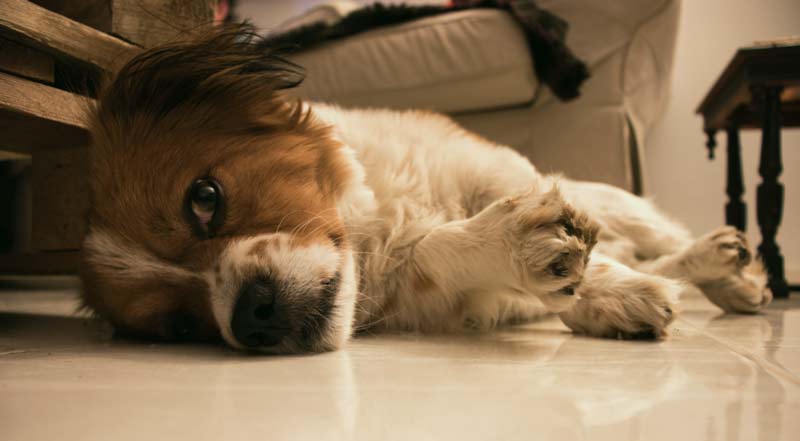
Overheating is the more common sleep temperature problem for household dogs. Dogs cannot regulate temperature through sweating. They rely on panting and seeking cooler surfaces, which means heat-related discomfort shows up quickly in sleep behavior.
Signs a dog is too hot during sleep:
- Panting during sleep or immediately after waking from even a short nap
- Repeatedly moving off their bed to lie on tile, hardwood, or any cooler surface
- Restlessness: unable to settle, circling, lying down and getting up repeatedly
- Sleeping fully stretched and flat rather than in any curled position, maximizing surface area for heat release
- Excessive drooling onto the bed surface during sleep
- Seeking the coldest corner of the room consistently
- Waking more frequently through the night without an obvious cause
THE QUICK AT-HOME TEMPERATURE CHECK
You can read your dog’s thermal state in about five seconds without a thermometer.
Back of the ear: place the back of your hand gently against the inside of the ear flap. Warm and slightly pink is normal. Hot and dry suggests the dog is running warm. Cool and pale suggests they may be cold.
Paw pads: touch the paw pads lightly. They should be warm but not hot. Hot, dry pads alongside panting are an early heat stress signal. Cold or pale pads in a warm room suggest the dog is struggling to maintain temperature.
Temperature alone does not tell the full picture. Humidity is a critical co-factor that most owners overlook entirely.
Dogs cool themselves primarily through panting, which works by evaporating moisture from the respiratory tract. In high humidity, evaporation is reduced.
A dog sleeping in a 74 degree room at 85% humidity is working far harder to cool itself than the same dog in a 78 degree room at 30% humidity. On humid summer nights, a dehumidifier or air conditioning makes more difference than opening a window.
HEAT STRESS: WHEN TO ACT
A dog that is actively panting, drooling heavily, seems confused, or is unresponsive is showing signs of heat stress, not just thermal discomfort.
Move the dog to a cool area immediately. Offer cool (not ice cold) water. Apply cool, damp cloths to the paws and belly, not ice packs.
Contact your vet if symptoms do not resolve within 10 to 15 minutes. Brachycephalic breeds (Bulldogs, Pugs, French Bulldogs) are significantly more vulnerable because their restricted airways make panting less effective as a cooling mechanism.
Dog Shivering in Sleep: Signs Your Dog Is Too Cold
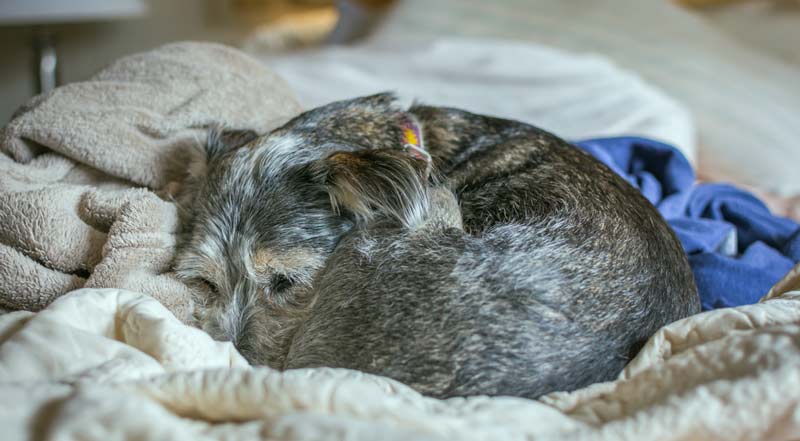
Cold is less commonly a problem than heat for most household dogs, but it is more common than owners realize, especially for small breeds, short-coated dogs, puppies, and senior dogs in winter.
Signs a dog is too cold during sleep:
- Dog shivering in sleep or trembling immediately after waking
- Curling tightly into a ball to conserve body heat
- Burrowing under blankets, cushions, or into corners during the night
- Reluctance to settle on the floor, preferring furniture or elevated surfaces away from drafts
- Waking more frequently than usual with no apparent reason
- Pressing against a heat source: a person, a radiator, or a sunny spot first thing in the morning
Is It Cold or Just REM Movement?
Not all shivering during sleep is cold. REM sleep produces muscle twitching in many dogs that can look like shivering from a distance. Anxiety and certain medical conditions also produce trembling.
Cold-related shivering is consistent across multiple nights when the temperature has dropped, and it resolves when warmth is provided. Shivering that persists despite a warm environment, or that occurs alongside other unusual symptoms, warrants a vet check.
Use the ear and paw check from section above. Cold ears and pale or cool paw pads in a sleeping dog suggest the room has dropped too low overnight.
Keeping Your Dog Cool at Night: Summer Sleep Tips
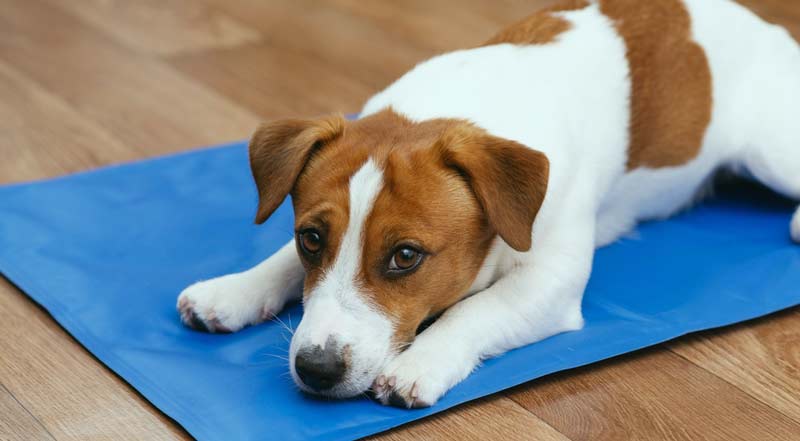
Keeping your dog cool at night in summer comes down to a few reliable interventions. Here is what actually works.
- Keep the room below 75 degrees Fahrenheit. Air conditioning or a fan running in the sleep room is the most effective single change. A fan alone in a room above 80 degrees -warm air without cooling it. The room temperature is the variable, not the airflow.
- Use a cooling mat. A gel or water-filled cooling mat placed in or near the dog’s bed provides a persistently cool surface the dog can move on and off as needed. The dog self-regulates. For our top-rated picks, see our cooling mats guide.
- Try an elevated bed. Raises the dog off the floor and allows airflow underneath. Particularly effective in humid conditions where floor-level air is stagnant.
- Keep cool water available overnight. Dogs that overheat during the night will drink if water is accessible. Fresh, cool water near the sleep spot removes one barrier to thermal recovery.
- Time exercise away from bedtime. Vigorous activity within two hours of bedtime raises core temperature. Evening summer walks should be calm and slow rather than high-energy. The body needs time to return to resting temperature before sleep.
On humid nights, reducing humidity matters more than reducing temperature. Air conditioning does both simultaneously, which is why it outperforms fans on muggy summer nights. If AC is not available, a dehumidifier running in the sleep room makes a meaningful difference.
What doesn’t work as well as owners think:
- Shaving double-coated breeds. The double coat insulates against heat as well as cold. Shaving disrupts this mechanism and can worsen thermoregulation, not improve it
- Fans alone in hot rooms. They circulate warm air without cooling it. Without reducing the room temperature, a fan provides comfort to the owner more than the dog
Dog Sleep in Winter: Keeping Them Warm Enough
Most indoor dogs in heated homes are fine through winter without any changes. The concern is more specific: small breeds, short-coated dogs, puppies, and senior dogs in rooms that get cold overnight.
When Winter Warmth Matters Most
- Small and short-coated breeds lose body heat quickly and benefit from a blanket in their bed year-round, not just in winter
- Senior dogs have reduced thermoregulatory efficiency. A consistently warm, draft-free sleep spot matters more as dogs age
- Dogs sleeping near exterior walls or in unheated rooms, where floor-level air is significantly colder than the thermostat setting
- Dogs in homes where the thermostat drops significantly overnight to save energy
Practical Tips for Winter Sleep
- Move the bed away from exterior walls and windows. Cold transfers through walls, and the floor near an exterior wall is measurably colder than the center of the room
- Provide a blanket the dog can burrow under if it wants to. Most dogs self-regulate well when given the option
- Raise the bed off the floor if the room gets cold overnight. Floor-level air is consistently the coldest part of the room
- For senior dogs and small breeds, a self-warming or gently heated dog bed provides consistent warmth without requiring the dog to generate it themselves
For dogs sleeping in unheated spaces: The thresholds are different from indoor ambient comfort.
Below 45 degrees Fahrenheit is uncomfortable for most dogs without adequate shelter and bedding.
Below 32 degrees Fahrenheit is dangerous for short-coated, small, elderly, young, or unwell dogs without appropriate insulated shelter. If outdoor temperatures regularly drop to these levels where your dog sleeps, moving them indoors overnight is the right decision.
How Temperature Disrupts Dog Sleep Stages
Temperature affects more than comfort. It directly affects which sleep stages a dog reaches and for how long.
A dog sleeping outside its thermoneutral zone spends more time in light sleep and less time in deep slow-wave sleep (SWS): the stage where physical repair, immune consolidation, and growth hormone release happen.
The hours spent asleep may look the same but the quality is not.
A 2022 study published in Behavioural Processes (Schork et al.) measured polysomnographic sleep in dogs under varying environmental conditions and found that temperature directly affected the amount of slow-wave sleep achieved.
Dogs in optimized environments spent significantly more time in deep sleep than those in disrupted or suboptimal conditions.
Getting the dog sleep temperature right is not about preventing discomfort. It is about protecting the sleep stages where the body actually recovers.
→ For the full guide to every element of an optimal dog sleep setup, see our dog sleep environment guide
What Your Dog’s Sleep Position Tells You About Their Temperature
Sleep position is one of the fastest behavioral reads for thermal comfort. Use it alongside the ear and paw check for a complete picture.
| Sleep Position | What It Likely Means Thermally |
|---|---|
| Curled tightly into a ball | Conserving heat. May be preference, may mean the dog is cold |
| Fully stretched out flat | Releasing heat. May be preference, may mean the dog is warm |
| On back, paws up | Maximum heat dissipation through the belly. Almost always a warm dog |
| Burrowing under blankets | Seeking warmth, consistently |
| Moving between bed and cool surfaces | Temperature is not right. Dog is actively regulating and not settling |
→ For everything else sleep positions reveal beyond temperature, see our guide on dog sleep positions
The Bottom Line
The ideal dog sleep temperature is 65 to 75 degrees Fahrenheit for most adult dogs. Your dog tells you when it is wrong through position, behavior, and the five-second ear and paw check.
Humidity matters as much as temperature on summer nights. Most fixes are simple: a cooler room, a cooling mat, a blanket, or a repositioned bed.
For everything about dog sleep in one place, visit our complete guide to dog sleep.