
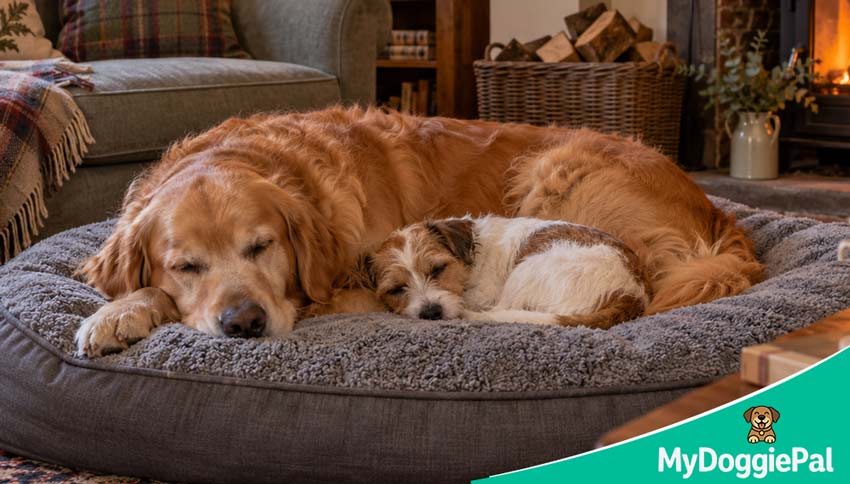
Multiple dogs sleeping arrangements can be the difference between calm nights and bedtime squabbles. The good news? Most problems come down to set-up, not “bad” dogs.
This guide covers whether your dogs should share, how to plan two dogs sharing sleep space, how to stop fights over beds and how to settle a new dog. It’s all force-free and research-backed, so you can start tonight.
YGive every dog its own bed plus one spare, spread the beds out with clear exits and let your dogs choose whether to share. Start with separate spots if one dog is new, unwell, elderly or protective of space
Let’s start with the big question.
Should Dogs Sleep Together?
There’s no single right answer to should dogs sleep together. Some pairs melt into one cuddly heap. Others need a few meters of breathing room. Both are completely normal, and the right choice depends on your dogs, not on a rule.
Why Many Dogs Love Sleeping Side by Side
Dogs are social animals. For many of them, a trusted buddy makes the night feel safer. Sharing body heat helps on cold UK nights, and a nervous dog often relaxes faster with a calm friend lying beside them.
Science backs this up.
In a Virginia Tech shelter study, dogs housed with a compatible buddy showed fewer signs of stress and were adopted about four days sooner. A 2026 follow-up study found that dogs returning to a shelter with a familiar companion settled back in more restfully than dogs paired with a stranger.
Notice that word familiar. It’s the bond that helps, not just having another dog in the room.
Where dogs sleep seems to matter far less than how relaxed they feel. An Australian study of 1,136 dog owners found 49% shared their bed with their dog, 20% kept the dog in the bedroom and 31% had them sleep elsewhere.
And a University of Toronto tracker study found that sleeping in the bed or nearby made no real difference to sleep quality.
When Separate Beds Are the Kinder Choice
Sharing isn’t right for every pair. And that’s okay. Give each dog their own spot if:
- One is a puppy and the other is a senior
- There’s a big size gap (think Great Dane and Jack Russell)
- One dog has arthritis or pain, or is recovering from surgery
- A female is in season
- One dog is restless, deaf or startles easily when bumped
- A new dog has just arrived
- Either dog has ever growled over a bed, toy or food
In these cases, sharing usually means worse rest for at least one dog. A snuggly pile sounds lovely, but a sore senior being bumped all night by a bouncy youngster won’t sleep well at all.
Separate beds in the same room often give you the best of both worlds: company without the crowding.
Quick Check: Are Your Dogs Ready to Share?
Tick these off honestly:
- They’re relaxed around each other all day
- Neither growls over toys, chews or food
- They’re a similar size and energy level
- Both are healthy and pain-free
- They already choose to lie together
My take: if you tick all five, let them try. If not, separate beds isn’t failure. It’s good care. Whatever you decide, the next step is the same. Plan the space.
Plan the Space Before You Buy the Beds
Good multiple dogs sleeping arrangements start with layout, not shopping. When we brought our second dog home, we bought one big bed and assumed they’d share it.
Within a week, one dog owned it and the other slept on the cold floor. The problem wasn’t the dogs. It was the set-up.
The “One Extra Bed” Rule
Here’s the simplest trick I know: Number of dogs + 1 = number of beds. So two dogs get three beds and three dogs get four.
Why does it work?
Competition only happens when something is scarce. With a spare bed, nobody has to wait, push or guard. When one dog gets up for a drink, the other can’t claim the only comfy option, and the returning dog always has somewhere to go.
It’s the cheapest peacekeeper you’ll ever buy.
Sizing a Bed for Two Dogs Sharing Sleep Space
If your pair loves to snuggle, one big bed for two dogs sharing sleep space can work well. Size it properly though, because a cramped bed is a recipe for grumbles.
- Measure each dog from nose to base of tail while they’re stretched out
- Use the longer dog’s measurement as the bed length
- Lie both dogs side by side, measure the width and add 15 to 20 cm
- Pick low sides so either dog can step out easily
Tip: if one dog keeps leaving the shared bed for the floor, they may simply be too warm. Keep a cooler spare bed close by.
Where to Put the Beds
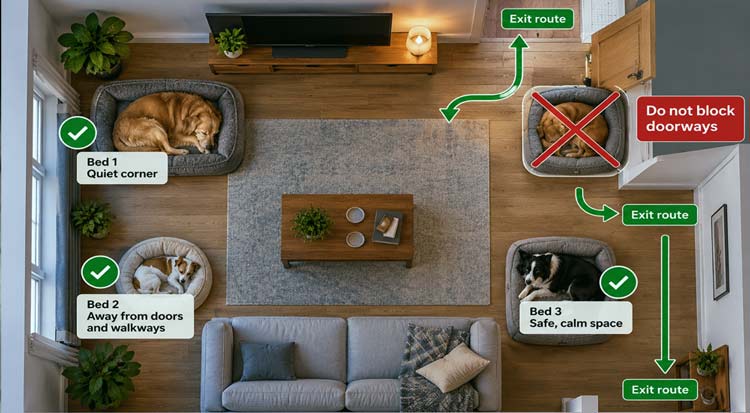
Placement matters more than most owners realise. Spread the beds out so your dogs aren’t forced nose to nose, and keep them away from doorways and narrow hallways. Those are pinch points, where one dog can easily block another.
Try to give every bed two ways out, so no dog ever feels cornered. Different heights help too, like a floor bed and a raised bed. Some dogs love a lookout spot, and offering choices spreads your dogs out naturally.
Living in a small terrace or flat?
Use opposite corners of the room, or put one bed on the landing. You’d be surprised how much calmer things get.
For help with light, noise and temperature, set up the perfect sleep environment for your dog
But what if one dog always grabs the best spot?
Pack Sleep Hierarchy in Dogs: Myth vs Reality
Search for pack sleep hierarchy dogs and you’ll find plenty of old advice:
The “alpha gets the best bed, so put him in his place” idea is everywhere. It’s also outdated.
The American Veterinary Society of Animal Behavior says dominance theory shouldn’t be used as a guide for changing behavior, and that comparing pet dogs to strict wolf packs misleads owners. You can read their position statement on dominance theory for yourself.
So why does one dog always take the best bed? Usually for simple reasons:
- It’s the softest or warmest spot in the house
- Habit, because it’s always been “their” bed
- Anxiety, wanting a safe corner
- It’s rewarding, especially if the bed is next to you
Here’s the part most articles miss. Guarding often depends on who is coming close. Your dog might happily share with one housemate but freeze when another walks over. That’s about the relationship between those two dogs, not rank. To go deeper, learn how dogs really relate to each other.
I’ll be honest, the dominance myth frustrates me. It pushes kind owners to punish worried dogs. Never force a dog off a bed or “put them in their place”. It usually makes guarding worse.
Still, sometimes a favorite spot really does spark a row. So what then?
Dogs Fighting Over Sleeping Spot: What to Do
Watching dogs fighting over sleeping spot is horrible. Your heart races and you just want it to stop. Thankfully, most bed squabbles give plenty of warning first.
The Warning Ladder
Learn these signs, from mild to serious:
- Stiffening when the other dog comes near
- A hard stare
- Freezing or lying “over” the bed
- Lip lift or showing teeth
- Growling
- Snapping or lunging
Step in at stages 1 to 3. And please never punish a growl. A growl is your dog saying “I’m uncomfortable“. Punish it and you lose your early warning system.

Why Bed Squabbles Suddenly Start
If your dogs got along fine until recently, look for something that’s changed. A new dog or puppy, pain or illness in one dog and extra attention going to one of them are all common triggers. Colder weather can play a part too, because a warm bed suddenly becomes far more valuable.
Moving furniture or beds catches lots of people out. We once moved a bed off a footstool and onto the floor, and our two dogs started a nightly bed war over it. Moving it back calmed things within a week. So change one thing at a time, and keep favorite beds where they are.
Tip: change one thing at a time and keep favourite beds where they are.
Force-Free Fixes, Step by Step
- Apply the one extra bed rule. More choice means less competition.
- Create separate sleep zones with baby gates or crates.
- Teach a “go to bed” cue using treats, so you can guide each dog to their own spot.
- Reward calm moments when one dog walks past the other’s bed.
- Take high-value spots off the table for now, like the sofa or your bed.
Be patient with this. Guarding comes from worry about losing something, so the goal is to prove there’s always enough to go round. That takes a few weeks of calm, rewarded nights, not one big moment.
If a Squabble Breaks Out at Night
STAY SAFE
- Never reach between fighting dogs
- Make a loud noise or drop a cushion between them
- Use a door or gate to separate them
- Check both dogs for injuries
- Keep them apart for the rest of the night
If squabbles keep happening, or anyone gets hurt, get help from a qualified behaviourist. The RSPCA suggests finding an ABTC-registered behaviourist, ideally through a referral from your vet. You can also understand and stop resource guarding in dogs
The easiest fights to fix are the ones you prevent when a new dog arrives.
Introducing a New Dog to the Sleeping Area
Getting the first nights right when introducing a new dog to the sleeping area saves weeks of stress later. Go slow and it always pays off.
The First Few Nights
Your new dog is tired, confused and maybe a little scared. Your resident dog is wondering who this stranger is. Give them both space.
- Set up the new dog’s bed or crate in a separate room or gated area
- Let your resident dog keep their usual spot, and don’t move their bed to make room
- Swap blankets between the dogs so they learn each other’s scent
- Walk them separately for the first few days
Purdue University’s Center for Animal Welfare Science advises introducing dogs on neutral ground first and watching for relaxed, give-and-take behaviour before moving on.
Not sure where your new arrival should sleep long term? Here’s how to choose the best place for your dog to sleep
A Week-by-Week Sleep Plan
If you’ve been searching for introducing new dog to sleeping area tips and find no real timeline. So here’s one:
| Stage | Sleep set-up | Goal |
|---|---|---|
| Days 1 to 3 | Separate rooms or gated areas | Decompress, no pressure |
| Days 4 to 7 | Same room, gate between beds | Calm in sight of each other |
| Week 2 | Same room, beds apart, spare bed added | Relaxed sharing of space |
| Week 3 onwards | Let the dogs choose | Natural preferences show |
Every dog moves at their own pace. If you spot stiffness or staring, go back a stage. No rush.
New Puppy With an Older Dog
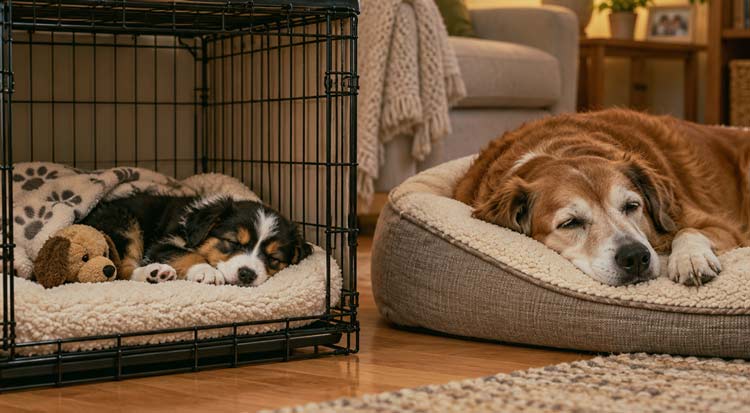
Puppies are adorable little night-time menaces. They wake up full of beans at 2am, and your older dog didn’t sign up for that. Crate the puppy near the older dog but not right beside them, so the pup has company without being able to pester.
Make the senior’s bed a puppy-free zone. If the youngster starts playing at night, calmly end it straight away. Night is for sleep, and your older dog deserves their rest.
Splitting Up Dogs Who’ve Always Shared
Maybe one of your dogs is now older or sore and needs their own bed. Make the change gradually:
- Move the beds a little further apart each night over one to two weeks
- Keep both dogs in the same room at first
- Reward each dog for settling on their own bed
The same steps work in reverse if you’d like two dogs to start sharing. Once everyone’s settled, a steady routine keeps it that way.
A Bedtime Routine That Works for Every Dog
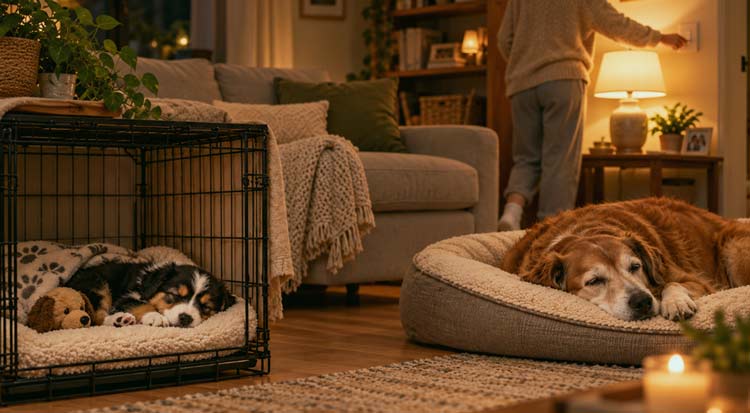
Dogs love knowing what comes next. A simple, repeatable routine lowers excitement and cuts bedtime squabbles.
- Have a calm hour before bed with no rough play
- Take each dog out for a last toilet break
- Give chews and food apart, so there’s nothing to guard
- Use the same settle cue, like “bedtime”, every night
- Dim the lights and keep things quiet
Night toilet tip: if one dog needs out at 3am, take only that dog. Otherwise you’ll wake the whole house.
Here’s something reassuring if you’re exhausted:
In the Toronto tracker study, owners with several dogs felt their sleep was worse, yet the trackers didn’t show it. So if you’re tired, check your routine before blaming the dogs.
Fireworks season warning: Bonfire Night can leave dogs jumpy and touchy at bedtime. Close the curtains, try some white noise and give beds extra space this week.
Not sure which set-up suits your home? Here’s what I’d recommend:
| Household | Recommended set-up |
|---|---|
| Two bonded adults | One large shared bed plus one spare |
| Puppy and senior | Separate beds, puppy crated nearby |
| Big and small dog | Separate beds, small dog raised or apart |
| Resident dog and new rescue | Separate rooms first, then follow the weekly plan |
| Three or more dogs | One bed each plus one spare, spread across the room |
Multiple Dogs Sleeping Arrangements: FAQs
Is it okay for two dogs to share a bed?
Yes, if both are relaxed, healthy and have room to stretch out. Watch for stiffness or staring and keep a spare bed nearby.
How many beds do I need for two dogs?
Three. The one extra bed rule means nobody ever has to compete for a comfy spot.
Is it fair to rotate which dog sleeps on my bed?
It can confuse dogs and make your bed feel extra valuable, which may spark guarding. A clear, steady rule usually works better.
Should a dog in season or after surgery sleep apart?
Yes. Give them a quiet, separate bed until they recover or their season ends.
Why does my dog steal the other dog’s bed?
Usually comfort, warmth or habit. The old pack sleep hierarchy dogs idea doesn’t hold up, so add a spare bed and reward each dog for using their own.
Do dogs sleep better together?
Many bonded dogs do, and research links calm companions with lower stress. So should dogs sleep together? Only if both of them want to.
Final Thoughts
Peaceful nights in a multi-dog home are absolutely possible. The best multiple dogs sleeping arrangements start with one extra bed, smart spacing and a slow, kind approach to new arrivals.
Above all, let your dogs show you what works.
Which set-up will you try tonight?
For more help, explore our complete guide to dog sleep