
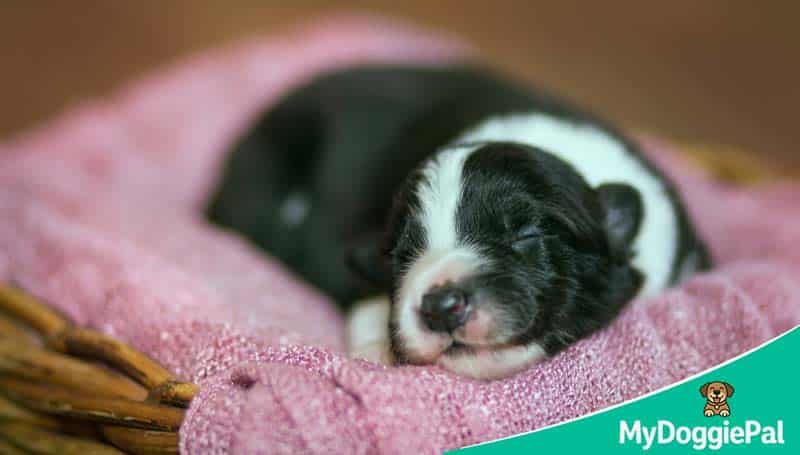
You’ve just brought your puppy home. And one of two things is happening.
Either they’re sleeping constantly and you’re worried something’s wrong. Or they’re refusing to sleep at night and you’re running on fumes.
Both are completely normal. Both will drive you slightly mad.
This guide gives you a clear, week-by-week puppy sleep schedule from 8 weeks to 6 months so you know exactly what to expect.
We’ll answer the two biggest questions new puppy owners ask:
- “Is my 8 week old puppy sleeping a lot – is that normal?” (yes)
- and “My puppy won’t sleep at night – what do I do?” (we’ve got you).
Getting sleep right now shapes your puppy’s behavior, health, and temperament for life. So let’s get it right. For the complete picture on dog sleep at every age, start with our complete guide to dog sleep
Why Do Puppies Sleep So Much?
So how much do puppies sleep? On average, 18 to 20 hours a day. That’s not laziness. That’s biology doing its most important work.
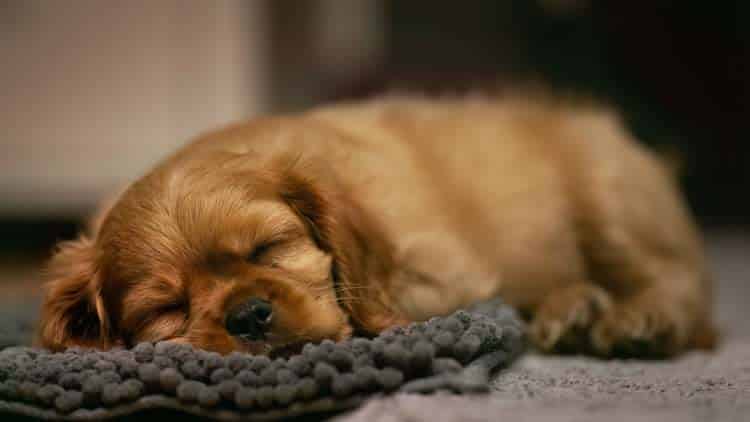
During sleep, your puppy’s body is releasing growth hormones, building their immune system, developing their brain, and consolidating everything they’ve learned that day.
According to the American Kennel Club, sleep is essential to the development of a puppy’s central nervous system, muscles, and immune function.
And here’s the part that catches every new owner off guard: puppies who don’t get enough sleep don’t get calm. They get more wired. More bitey. More zoomie. More impossible.
Signs your puppy isn’t getting enough sleep: lower appetite, reduced playfulness when awake, increased mouthiness and harder biting, irritability, and difficulty learning or retaining training. If you’re seeing these consistently, your puppy probably needs more rest not more activity.
How much do puppies sleep varies a bit by breed. Larger breeds tend to sleep more. Smaller breeds may have more intense bursts of energy between naps.
The amount of sleep your puppy needs shifts as they grow which is why a puppy sleep schedule broken down by age is so useful. Here’s exactly what to expect.
Puppy Sleep Schedule: Week by Week (8 Weeks to 6 Months)
| Age | Total Sleep / 24hrs | Night Sleep | Daytime Naps | Night Waking? |
|---|---|---|---|---|
| 8–10 week | 18–20 hrs | 6–8 hrs (with breaks) | 5–6 naps | Yes. Every 2–3 hrs |
| 10–12 weeks | 18–20 hrs | 7–8 hrs (with breaks) | 4–5 nap | Yes. Every 3–4 hrs |
| 12–16 weeks | 17–19 hrs | 7–9 hrs (longer) | 3–4 naps | Reducing |
| 4–5 months | 16–18 hrs | 8–9 hrs (most through) | 3–4 naps | Rare |
| 5–6 months | 15–17 hrs | 8–10 hrs | 2–3 naps | Unlikely |
These are averages. Your puppy may sit at the top or bottom of each range depending on breed, activity level, and temperament. The key is whether they’re alert, playful, and eating well when awake.
8–10 Weeks (The Sleepiest Stage)
Your puppy will sleep around 18 to 20 hours a day. If you’re thinking “my 8 week old puppy sleeping a lot, is this normal?” Yes. Completely.
At this age, puppies sleep in very short bursts. They wake up, eat, play for 30 to 45 minutes, then crash again. It’s a rapid cycle and it’s exactly how it should be.
Night waking is guaranteed. Tiny bladders mean your puppy physically cannot hold it through the night. Expect to get up every 2 to 3 hours for toilet breaks.
This stage is exhausting for owners. It feels relentless. But it passes faster than you think.
Tip: Keep night-time toilet trips boring. No lights, no talking, no play. Out, toilet, straight back to bed. You’re teaching your puppy that night-time is for sleeping, not socialising.
10–12 Weeks (Small Improvements)
Sleep stays around 18 to 20 hours, but night-time stretches start getting slightly longer. You might get 3 to 4 hour blocks which feels like a miracle after the first week.
Daytime naps are still frequent, 4-5 per day. Your puppy may start resisting naps because the world is too exciting. This is where enforced naps become your best friend.
The overtired puppy spiral is real at this age. A puppy who won’t nap becomes increasingly frantic, bitey, and impossible to manage. If your puppy is acting like a tiny demon in the evenings, they probably need sleep not more stimulation.
Tip: Crate or pen in a quiet room, cover with a blanket, walk away. They’ll protest briefly and then pass out. Trust the process.
12–16 Weeks (The Turning Point)
Total sleep drops slightly to 17 to 19 hours. Night sleep starts consolidating — many puppies sleep 6 to 8 hours without a toilet break by 14 to 16 weeks.
This is often when owners first feel human again. Longer stretches at night. Fewer daytime naps. A rhythm starting to form.
Bladder capacity is increasing. Most puppies can hold it for roughly 1 hour per month of age. So, a 4-month-old can manage about 4 hours.
Socialisation is in full swing, and sleep is critical for processing everything your puppy is learning. According to research from the Journal of Veterinary Behavior, puppies who nap after training sessions retain significantly more of what they learned. Every nap is part of the learning process.
4–5 Months (Settling Into a Routine)
Sleep drops to around 16 to 18 hours. Most puppies are sleeping through the night by now — 8 to 9 solid hours. Can you imagine?
Daytime naps reduce to 3 to 4, and your puppy will start to develop a more predictable routine. This is a great time to lock in a consistent puppy sleep schedule. Set nap times, walk times, and bedtime at roughly the same time each day. Consistency helps their internal clock settle.
Some puppies hit a rough patch around this age where they seem to forget how to settle. That’s not regression, that’s adolescence starting to kick in. More on that below.
5–6 Months (Approaching Adult Patterns)
Total sleep: 15 to 17 hours. Night sleep is typically 8 to 10 hours straight. Daytime naps reduce to 2 to 3.
By 6 months, most puppies have a settled daily rhythm — though adolescence can throw some curveballs at you.
For the full picture on how sleep needs continue to change into adulthood and beyond, see our guide on how much sleep does a dog need, broken down by age, breed, and health
Now that you know the week-by-week breakdown, let’s put it into a practical daily schedule you can actually use.
Sample Daily Puppy Sleep Schedule (12-Week-Old Example)
| Time | Activity |
|---|---|
| 7:30–8:15 AM | Play, training, socialisation |
| 8:15–10:00 AM | Nap (crate or pen) |
| 10:00 AM | Toilet break, short play |
| 10:30 AM–12:00 PM | Nap |
| 12:00 PM | Toilet break, lunch, play |
| 12:45–2:30 PM | Nap |
| 2:30 PM | Toilet break, walk or play |
| 3:15–5:00 PM | Nap |
| 5:00 PM | Toilet break, dinner, play |
| 6:00–7:30 PM | Nap or calm settle time |
| 7:30 PM | Final toilet break, wind-down routine |
| 8:00 PM | Bedtime |
| ~11:00 PM | Night toilet break |
| ~3:00 AM | Night toilet break (may not be needed) |
Adapt this to your own life, the exact times don’t matter as much as the rhythm of wake-nap-wake-nap. The golden rule at this age: roughly 45 minutes to 1 hour awake, then 1.5 to 2 hours of nap.
The Sleep-Eat-Play cycle: If a timed schedule feels overwhelming, think of it as a repeating loop instead. Your puppy sleeps, wakes up, eats (or has a toilet break), plays or trains for a short window, then sleeps again. Toilet breaks between each stage. That cycle is the schedule.
Now for the question that keeps new puppy owners awake at 3AM – literally.
My Puppy Won’t Sleep at Night: What to Do
Why Puppies Struggle at Night
If your puppy won’t sleep at night, you’re not doing anything wrong. Here’s what’s going on:
Separation from the litter. Your puppy has never slept alone before. They’ve spent every night of their life in a warm pile of siblings. This is a massive transition.
New environment. New smells, new sounds, new rules. Some puppies sleep well the first night out of sheer exhaustion, then struggle on nights 2 to 4 as they start to come out of their shell.
Tiny bladder. They physically need to go during the night. There’s no way around this one — just through it.
Overtiredness or under-tiredness. Both cause settling problems. A puppy who hasn’t had enough activity during the day may be restless. A puppy who’s had too much stimulation may be wired and unable to wind down.
How to Help Your Puppy Sleep Through the Night
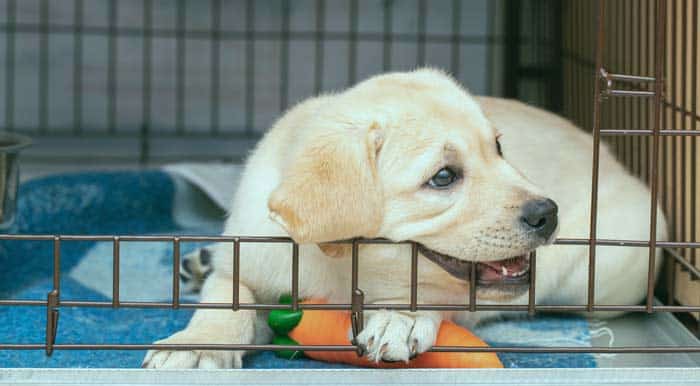
1. Start with the crate near you. Having your puppy sleep in your bedroom, not necessarily in your bed during the first few weeks massively reduces night crying. They can hear you breathing and know they’re not alone. Gradually move the crate to its final location over 1 to 2 weeks.
2. Check the crate size. Big enough to stand, turn, and lie down. Not so big they can toilet in one corner and sleep in the other. As your puppy grows, check regularly that they haven’t outgrown it. Feeling cramped causes night waking.
3. Ask your breeder for a scent item. A blanket or soft toy that smells like their mother and littermates can be incredibly soothing. Place it in the crate for the first few weeks. This works alongside (not instead of) a heartbeat snuggle toy.
4. Create a sleep-friendly environment. Dark room, comfortable temperature, white noise or a low radio. Cover wire crates with a blanket to create a den-like feel. For the full setup guide, read our article on how to create the perfect sleep environment for your dog.
5. Try a DAP diffuser. Products like Adaptil release a synthetic version of the calming pheromone a nursing mother produces. Plug one in near the crate. It’s not magic, but many owners find it takes the edge off night-time anxiety.
6. Wind-down routine (specific steps). About 30 minutes before bedtime: put away all toys, dim the lights, stop all high-energy play and no tug, no chase. Speak in a calm, low voice. Some owners play soft classical music. Same routine every single night. Your puppy will learn the signals fast.
7. Food and water timing. Feed the last meal at least 2 to 3 hours before bedtime so your puppy has time to digest and toilet. Limit water in the final 1 to 2 hours before bed (but never restrict water during the day). This directly extends how long they can sleep without needing a toilet break.
8. Set a proactive alarm. Instead of waiting for your puppy to cry, set your own alarm to take them out before they need to signal. This prevents them from learning that crying = being let out. As they mature, push the alarm later and later until it’s no longer needed.
9. Don’t reward crying with attention – but don’t leave a distressed puppy to scream either. There’s a middle ground. Wait for a brief pause in crying, then calmly take them out for a toilet break without fuss. Never punish a puppy for crying at night.
10. Be patient. Most puppies start sleeping through the night between 12 and 16 weeks. It feels like forever. It’s not.
If you’re in the first week and everything feels chaotic, our guide on settling a new dog who won’t sleep in the first week has you covered.
Puppy Sleep Regression: Is It a Real Thing?
Your puppy was sleeping through the night. You were finally getting rest. And then out of nowhere, they’re waking up again, crying, refusing to settle, fighting naps they used to take happily.
Sound familiar?
You’re dealing with puppy sleep regression. It’s not a clinical term, but it’s a very real experience.
It typically happens at two points:
Around 4 months (teething). Sore gums make it hard to settle. Your puppy may chew on the crate, whimper, or wake more often. Offer a frozen chew toy or cold washcloth before bed.
Around 6–8 months (adolescence). Hormonal changes, increased independence, and boundary-testing. Your puppy may suddenly resist the crate or push back on the bedtime routine they used to accept.
What to do: Stick to the routine. Don’t change the rules because of a bad week. Puppy sleep regression is temporary, the routine you built will carry you through it.
If regression comes with other symptoms like lethargy, appetite loss, vomiting, it may not be behavioral. See your vet.
New Puppy Sleep Training: Setting Good Habits Early

New puppy sleep training isn’t about rigid rules. It’s about building habits that make sleep easy and natural for your puppy and for you.
Crate training is your best sleep tool. The crate should be a positive, safe space, never a punishment. Feed meals in it. Scatter treats. Let your puppy explore it during the day with the door open. When the crate feels like their den, bedtime becomes easy.
Check the crate size as your puppy grows. Puppies grow fast. A crate that was perfect at 8 weeks can be too small by 12 weeks. If your puppy seems restless or is waking more, the crate may simply be too cramped. Many owners buy a larger crate with an adjustable divider.
Same bedtime every night. Puppies are creatures of habit. They lock onto patterns quickly. A consistent bedtime – same time, same routine – helps their internal clock set.
Separate sleep from attention. Your puppy needs to learn that sleep time means quiet time. No play, no fuss, no prolonged goodnight rituals. Calm and boring is the goal.
Don’t start your puppy in your bed if you don’t want them there long-term. It’s much harder to undo that habit later. The crate near your bed gives closeness without creating a dependency.
For a full step-by-step crate training guide, see our crate training article.
And now, a section that no one talks about enough but everyone going through it needs to hear.
The Puppy Blues – It’s Normal to Feel Overwhelmed
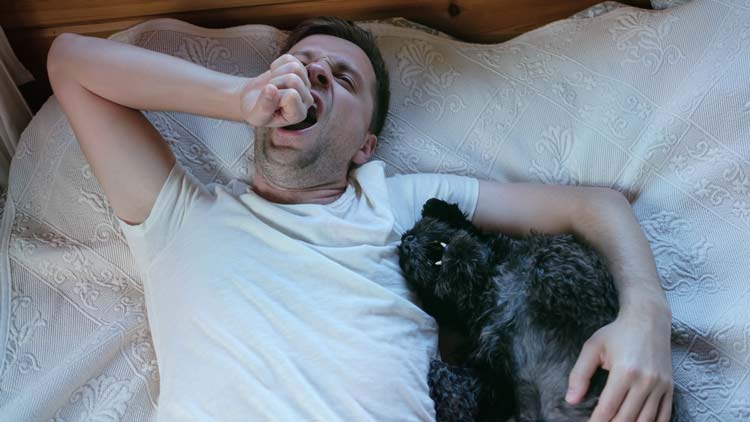
Let’s be real for a moment.
The first few weeks with a new puppy can be brutal. Sleep deprivation is no joke. You’re getting up multiple times a night. Your puppy is crying. You’re second-guessing every decision.
And somewhere around day four, a thought creeps in: “Did I make a mistake?”
This feeling has a name: the puppy blues. And it’s far more common than anyone talks about.
You’re not a bad owner. You’re not failing. You’re in the hardest part and it’s temporary.
It gets better. Usually dramatically better between 12 and 16 weeks, when your puppy starts sleeping through the night and the routine clicks into place.
In the meantime: nap when your puppy naps. Accept help. Lower your expectations for a tidy house. And remind yourself that the sleepless phase is weeks, not months.
Frequently Asked Questions
Is my 8 week old puppy sleeping a lot – is that normal?
Yes. An 8 week old puppy sleeping a lot is exactly what you want. At this age, 18 to 20 hours of sleep per day is normal and essential for healthy development. If your puppy is alert and playful when awake, there’s nothing to worry about.
When will my puppy sleep through the night?
Most puppies start sleeping through the night between 12 and 16 weeks. Some manage it earlier, some later. A consistent puppy sleep schedule, a good bedtime routine, and a comfortable crate setup all help speed things along.
How many naps should a puppy take per day?
At 8 to 12 weeks, expect 4 to 6 naps per day. By 5 to 6 months, that drops to 2 to 3. The exact number matters less than making sure your puppy is getting enough total rest.
Should I wake my puppy up from a nap to take them outside?
Only if it’s been a while and they’re likely to need a toilet break. Otherwise, let sleeping puppies lie. Waking them unnecessarily disrupts the deep sleep they need for growth and development.
Is puppy sleep regression normal?
Puppy sleep regression is a very real experience for owners. It usually hits around 4 months (teething) or 6 to 8 months (adolescence). Stick to the routine and it will pass. If it comes with other symptoms like lethargy or appetite loss, see your vet.
Should I restrict water before my puppy’s bedtime?
Limiting water in the final 1 to 2 hours before bed can help extend how long your puppy sleeps without a toilet break. But never restrict water during the day — puppies need free access to fresh water when they’re active. If your puppy won’t sleep at night because of frequent toilet trips, adjusting food and water timing is one of the most effective fixes
The Bottom Line
Puppy sleep is intense. It’s exhausting. And sometimes it’s baffling. But it follows a pattern and once you know the pattern, it gets so much easier.
Use the week-by-week schedule and sample daily routine as your roadmap. Or keep it simple with the Sleep-Eat-Play cycle. Adjust as needed for your puppy’s breed, size, and temperament.
A well-rested puppy is a calmer, happier, better-behaved puppy. Every single nap is doing important work.
If you’re still in the sleepless early days, hang in there. It really does get better. Usually by 14 to 16 weeks, you’ll be sleeping through the night again.
Your puppy won’t be a puppy forever. But the sleep habits you build now? Those last a lifetime.